


Black America Rewind: 1980s
Jun 17
27 min read
Our history will not be erased. In this series, we'll focus on important Black American history from the 1920s to the 1990s. Full posts are available here, but you can follow along with the abridged versions on Instagram, too.
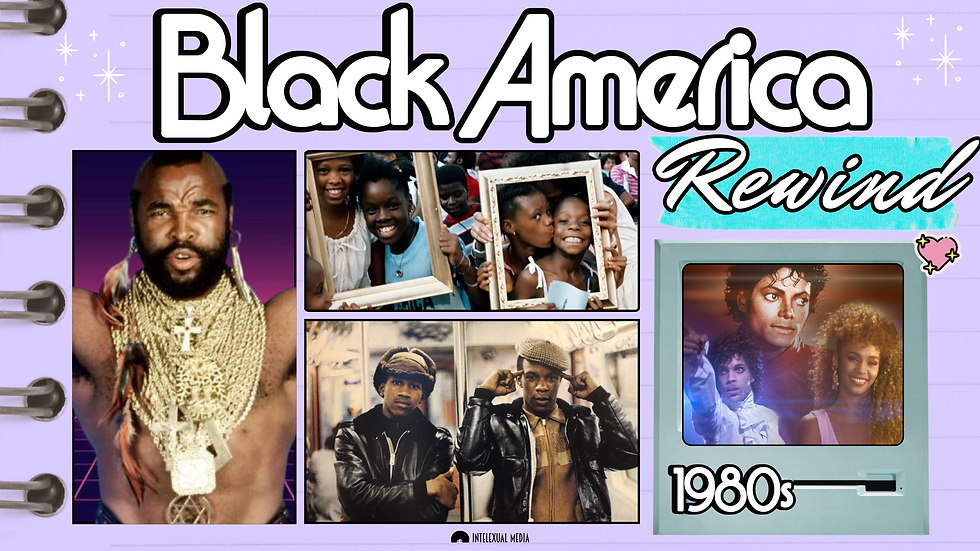
The 1980s were a magical era of Black political, cultural, and social power. While racism was never too far behind, the Black American community continued to step into the future with ingenuity, cooperation, and style.
Table of Contents
1980s Figure Spotlight: Oprah
1980s Trends, People, & Performers
1980s Figure Spotlight: Jesse Jackson
1980s Ripple Effects

Important 1980s Events

Mass Incarceration and Trickle Down Economics
Drug-related gang violence
Broken Windows Theory
Slashing the tax rate of rich people and gutting public services for poor people-- AKA 'Reaganomics' and 'Trickle Down Economics'
Proposals for harsher sentencing for offenders
Discussions of “Black on Black Crime”
Stratification of Interests
Republicans vs democrats
Socially conservative vs socially liberal
Men vs women
Wealthy vs Poor
Pro vs. Anti-Welfare
Demographics Shift
In 1980, there were 816,000 total Black immigrants from Jamaica, Haiti, Nigeria, etc, in addition to 27 million black Americans. By 1990, there were over 1.4 million total black immigrants, and more in other racial groups. Experts predicted Latinos were on track to become the biggest minority.
The Crack Problem

The Results of Urban Decay
Lack of opportunities and resources meant more drug dealing and drug use, enabled by the flow of cocaine from the Iran-Contra scandal
More drugs meant more gangs and an illicit industry that thrived on paranoia and violence
In the 80s, 62% of all drug-related homicides involved black victims
The Len Bias Tragedy

In 1986, Maryland native Len Bias seemed to be at the top of the world. The 22-year-old University of Maryland basketball player was being compared to Michael Jordan and had collected his second ACC Player of the Year Award. On June 17th, he was selected by the Boston Celtics as the second overall pick in the NBA draft. He was already in negotiations to accept a $1.6 million endorsement deal with Reebok. By Juneteenth, he would be dead of a cocaine overdose. His drug overdose, though high profile, was just one of many affecting the black community in the 80s. Bias’s parents were dealt another blow when, in 1990, the second of their four children, Jay, was killed in a drive-by shooting. The grief of these parents would motivate them to participate in anti-drug and gun control policy discussions, symbolizing two major concerns for the black community at large in the late 80s.
Drugs and Criminalization
Several high-profile Black politicians called for more policing (see below)
Drug dealers held a certain prestige for the wayward, but were seen by many other Black people as race traitors. The Nation of Islam notably sent its Fruit of Islam security wing into projects to assault drug dealers.
Fear of violence, addiction, and crack babies made Reagan’s acceleration of the War on Drugs more palatable
'Black on Black Crime'

In 1979, Ebony magazine dedicated an issue to detailing black people’s growing alarm at the harm being perpetuated by their own in their own communities, discussing the term “black on black crime”, which they predicted would be a big problem in the following decade if nothing was done. They listed the causes as hard drugs, an inadequate prison system, racism, tv and movies, and a lack of morality. Several “cures” were presented, including a return to religious morality and correcting economic justice, the latter put forth by Congressman John Conyers.
Winston E. Moore, however, the chief of security for Chicago’s housing projects and the first black warden of a Cook County Jail, wrote a popular piece, saying, “It is my conviction that we will never put an end to the mounting problem of black on black crime unit we stop coddling the hoodlums. Not only are these criminals allowed to prey on their law-abiding brothers and sisters with virtual impunity, they have attained bonafide hero status among many young blacks…” He called for severe crackdowns on drug pushers, while pointing out that the fastest-growing crime in the black community was rape, of which nothing was being done because of stereotypes about black women. Only one year later in another editorial he would blame black mothers for homosexuality, rape, and femicide.
Atlanta’s chief of police, George Napper, who was demanding community accountability, wrote,
“On too many occasions, friends have told me that they have gone out of their way to say corrective words to a nine-or-ten-year old youngster, only to be cussed out… further, when reporting the incident to the child’s mother or father, more obscenities were forthcoming. Obviously, and unfortunately, the next time the youngster is involved in a similar situation, there will be a tendency to call the police and have them deal with it. Too many of our kids who can be controlled in the neighborhood… end up being treated (or mistreated) by the criminal justice system.”
This quote demonstrates that while many black Americans acknowledged the damage and violence of the American legal system, the growing disconnect from community and shared racial values in the face of rising crime made calling cops on each other a bit easier, especially if you had witnessed or been a victim of a crime. Numerous Ebony subscribers wrote into the magazine agreeing with Winston Moore’s demands to “stop coddling the hoodlums.”
The Reagan Presidency (1980-1988)

Among many things, Reagan attempted to weaken the Voting Rights Act, nominated the racist Jeff Sessions to a federal court, and accelerated the War on Drugs that contributed to mass incarceration and the crack addiction industry that ravaged many segments of the Black community. He also promoted Trickle Down Economics and cut funding for public services, invoking the Black welfare stereotype as he did so
By ignoring the HIV/AIDs crisis until 1985 (first mentioning it publicly) and 1986 (finally funding a research commission), Reagan’s administration allowed conspiracies to fester and rates of infections to grow larger, eventually becoming more common among Blacks than whites in 1988
Approximately 70% of Black Americans disapproved of Reagan
The 1980s Buppies
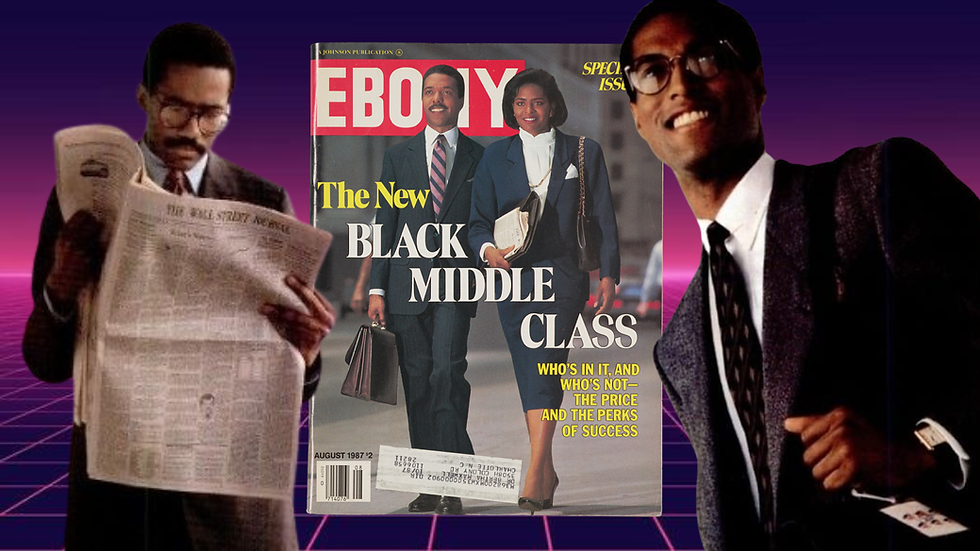
"Black Urban Professionals" were the approx. 21% of Black Americans who qualified as professional/ upper class
They lived in enclaves like Hamilton Heights (Harlem), Baldwin Hills (LA), MacGregor Park (Houston), Cascade Heights (ATL), and Chatham (Chicago)
They became an important voting bloc, with the LA Times detailing in 1985, “They are more politically active, more critical of traditional black leaders, more distrustful of whites in general and, most importantly, more likely than other blacks to vote.”
They had a variety of priorities that sometimes put them at odds with their race and class:
Different from the previous generations of wealthy Black people, because they were typically born poor
Faced racism with their class and at work
One millionaire quoted in the article, Dempsey J. Travis, hinted that it was all smoke and mirrors. “I’ve studied this thing for years, and I can tell you that blacks with money may travel in the same direction as whites with money, but we’re never a real part of them. You may even have more money than they have, but in most cases, you’re just a rich, lucky black. You’re different and they never let you forget it.”
Owned property and became landlords
Favored litigation and electoral politics over direct action and protest. Buppies who grew up as participants in the protesting days of the civil rights movement changed their tactics.
“Years ago, we picketed buildings because we didn’t know who the owners were, and we didn’t know how else to get our point across. Now we pick up the phone and call the owner and try to persuade him. If I don’t know him, somebody I know does,” said one buppie in 1985. Said another, “Sure, I want my BMW, I want to live comfortably, but I want health care for poor black people too. "
Like-minded buppies started political action committees, created programs for their own communities, helped to mentor aspiring college students through sororities and fraternities, and exercised what Jesse Jackson referred to as “enlightened self-interest.” Knowing the precariousness of black success and wealth in a white supremacist world, buppies organized to create their own non-partisan “old-boys network.” When criticized as 'Uncle Toms', one buppie challenged back in the Chicago Tribune,
“It is for the sake of our young people, not the egos of my fellow buppies, that I voice my concern. We see the evidence of black failure all around us. Crime. Illiteracy. Teen pregnancy. The new urban underclass. Declining black college enrollment. Why do we not do more to encourage black success?”
1980s Spotlight: Black Women

Black women were beginning to see new gains and success that were previously unavailable to their female ancestors. Their labor demographics were also starting to change. In 1960, 60% of all black women were service workers, compared to 20.3% of white women. By 1989, only 27.3% of black women were in service positions, compared to 16.1% of white women. The pay disparity was very real, with women of all races earning an average of 33 cents less than men an hour at the start of the decade. Race, of course, often made the disparity worse. Though many of the black women who left service found better pay, only 23.1% went into “better-paying professional or technical work.” Most went into retail. Some went to work for themselves. In 1980, black women owned almost 27,000 of the country’s businesses, or 11.5% of all black businesses and 3.5% of women-owned firms. These numbers would only grow. At the end of the decade, 31% of black women who graduated from high school enrolled in college, up from 29% in 1980.
Out of 490,770 elected officials in America in 1987, 6,700 were black and 1560 were black women, or 0.3% of the total. The overwhelming majority were democrats, though there were vocal black republican women too. There were black female mayors of tiny towns of less than a thousand like Unita Blackwell in Mayersville, Mississippi and there were black women mayors in cities with populations over 50,000 like Lottie Shackleford of Little Rock Arkansas, for one year because of an appointment, and Jessie M. Rattley of Newport News. Rattley lost her re-election because she drew heat for wanting to expand low-income and affordable housing into white and upper-class areas. Behind the rise of black women in elected positions were black female voters— across the board.
At the Republican National Convention in Dallas in 1984, there were 2,234 total delegates. Of the 36 black delegates present, 32 were black women. At the Democratic National Convention, black women were 388 of the 710 total black delegates. Interviews of black women leaders at the time showed they felt slighted by the 1984 elevation of both VP-nominee Geraldine Ferraro and presidential hopeful Jesse Jackson. Said Shirley Chisholm, “Black women are not considered for anything important in this country… Neither the black movement nor the women’s movement have been able to address themselves particularly to the black community.”
In 1984, the National Black Women’s Political Caucus was founded in response to the Vice Presidential nomination of Geraldine Ferraro by Walter Mondale, with Shirley Chisholm, fresh off her retirement from Congress, serving as chair. The committee was bipartisan, and republican and Reagan supporter Gloria Toote served as vice chair. The caucus planned to “form coalitions with other women's organizations from a position of strength…” The same year the caucus was founded, historian and lawyer Mary Frances Berry, and lawyer and caucus member Eleanor Norton became instrumental organizers of the Free South Africa Movement, a coalition of groups determined to abolish apartheid. Further organization was catalyzed after activists Walter Fauntroy and Randall Robinson, along with Berry, were arrested during a staged sit-in at the South African Embassy. Anti-apartheid protests followed across multiple college campuses.
Clearly, black women were involved with more ways to connect and organize than ever before. But this also meant exposing many differences in opinion. In 1985, Empowerment: A Black Woman’s Issue, was hosted by author, historian, and feminist Paula Giddings at the New York Public Library. The panelists included Jewell Jackson McCabe, president of the National Coalition of 100 Black Women, which had 3,000 members in 19 states and 47 chapters by 1986. The coalition had begun hosting the Candace Awards at the New York MET for intellectual and creative pursuits by black women back in 1982, with awards going to women like activists Ella Baker and Rosa Parks, historian Nell Irvin Painter, and ballerina Janet Collins.
At the Empowerment panel, Jewell cited black women’s alleged $183 billion dollar buying power and noted that black women voted in the last election at a higher percentage than black men or white women. She also criticized white women’s organizations and said that black women taking black men's jobs was a myth. The second panelist was Toni Luck, a republican, Reagan campaigner, and business owner who advocated for self-esteem and black women switching to the republican party. She said, “You’ve got to play the game of the land you’re in. We’re in a capitalistic country and that means making money, and if you don’t agree, go to Russia.” The final panelist was Althea Simmons, the Chief lobbyist of the NAACP. She urged black women to lobby, organize at the grassroots level, and put pressure on Congress to care about black women’s causes. The three panelists represented mainstream concerns and solutions held by politically-minded black women focused on electoral politics in the 1980s.

More than ever, black feminist works were being published and circulated. 1981 saw the publishing of This Bridge Called My Back: Writings By Radical Women of Color, including pieces by Toni Cade Bambara, Audre Lorde, and Pat Parker, as well as Latina and asian writers. That same year, bell hooks published Aint I A Woman, exploring the racism and misogyny black women historically faced, including in the black nationalist and feminist movements. Angela Davis published Women, Race, and Class in 1983, detailing the unique ways that black women experience life and hardship because of misogyny, racism, and classism. Sister Outsider was published in 1984, a collection of works by Audre Lorde that explored feminism from a postcolonial feminist and lesbian perspective, addressing everything from homophobia to classism to ageism. Paula Giddings also published one of my favorite history books, When and Where I Enter: The Impact of Black Women on Race and Sex in America, a thorough work detailing black women’s existences as well as their political actions and social habits through the centuries. This flurry of black women publishing books was also accompanied by a new feminist framework: womanism, which is more broadly intersectional than the former term. Though it has changed in meaning and interpretation for years, it was first used by The Color Purple author Alice Walker in 1979 and later expanded in 1983, with her writing that “Womanist is to feminist as purple is to lavender.” Speaking of Alice Walker, the 1985 adaptation of her novel caused controversy within the Black community.

1980s Quick Facts & Cost of Living
Black population by 1980: 26.5 million (11.7% of the U.S.)
Black Female Birth Rate by 1980: 88.1 per 1000 women
Black Female Marriage Rate by 1990: 24-27%
Black Female-Led Homes in 1980: 37-40% (compared to 11% for white women)
National Divorce Rate by 1980: 19 per 1000 marriages
Interracial Marriage: In 1980, 122,000 black men were married to white women in 1980, a number that would grow to 150K by 1990. Comparatively, black women who were married to white men was 45,000 in 1980 and 61,000 by 1990.
Black-owned Businesses: 308,260 in 1982 and 424,165 in 1987
Black Homeownership: The number of Black homeowners grew from 3.7 million in 1980 to 4.3 million in 1990
Median Annual Family Income in 1985 (Modern $): White: $29,152 Black: $16,786
Black Family Poverty Rate (1988): 31.6% (compared to 10.1% of white Americans). By 1990, the median income for black families was 42% below the median income of white families.
Common Jobs: Retail, service, military service, federal employees, USPS, caregivers, nurses, manual laborers, machine operators, clerical, beauticians, barbers, business owners, salesmen
States With the Biggest Percentage of Black People: Mississippi, Louisiana, South Carolina, Georgia, Maryland

Important 1980s Ideas
Going 3rd Party
In 1980, the National Black Independent Party attracted around 2000 delegates to its founding convention. Attendees strategized on how to work within the electoral arena, and its charter and constitution called for equal gender representation. The party lasted for six years. Even though established as an alternative party, they pushed Harold Washington’s 1983 bid for Chicago mayor & Jesse Jackson’s 1984 presidential bid.
Black Excellence
The expansion of Black Cultural and History Studies
More visible Black wealth, positive media, and celebrities who were tasked with representing the race in the best light, like The Cosby Show
More promotion and private funding of HBCUs
Black Conservatism
Bootstrap narrative rhetoric that fit the Trickle Down Theory of the Reagan era
Embodied by men like Clarence Thomas and Thomas Sowell
Promotion of individualism over community and a disbelief in systemic racism
The female strain of Black conservatism saw women like Sharazhad Ali command Black women to be submissive and weak to attract and keep Black men
Gaining Local Power

At the end of the 70s, over 200 cities had elected black democrat mayors who inherited a lot of problems. For starters, conservatism was a dominant ideology in many areas, meaning a rejection of programs and policy proposals that seemed too radical, liberal, and softhearted. The demise of well-paying jobs from deindustrialization meant new expectations to help formerly employed people find housing and jobs, and resist the lure of drugs, which seemed to be flooding the streets. By 1987, the black unemployment rate was double that of whites. Liberals and leftists wanted social spending, but there was a declining taxpayer appetite for social spending, meaning that implementing too many programs and raising taxes, especially if those programs would help minorities, was treated with hostility. As Bradford Martin wrote in The Other Eighties, these black mayors needed to figure out “how to leverage jobs and services to improve the lives of the poor and minority citizens from the pro-growth business community that represented [the] best hope for economic revitalization in an age of declining public investment.” Shrinking tax revenue from white flight meant these mayors turned to whoever was willing to give money…. like real estate developers and investors who wanted to build downtown financial centers.
This was the case for Tom Bradley of LA, a former cop who developed the downtown business district at the expense of poor communities, whose jobs had dried up when rubber and steel plants shut down. So it was black mayors suffering the consequences of deindustrialization, as well as the devolution tactics used by Nixon and Reagan, needing the approval of moneyed private citizens to provide what should have been basic public services. Also, while white mayors didn’t have to worry about appearing to be fair to all races, black mayors did— and were often criticized and challenged for trying to make up for years of inequity.
Take Harold Washington of Chicago, whose 1983 mayoral campaign was about “self-determination and community control.” He had originally came to prominence as an Illinois State Representative, expected to stick to the party script until he supported legislation addressing police brutality in Mayor Richard Daley’s Chicago. The city was notoriously run by a democratic machine built on patronage and party loyalty— so speaking against the mayor of his party lost him internal political clout. Washington wasn’t radical, perhaps demonstrated by his silence on the assassination of Fred Hampton in 1968, but his commitment to mainstream black causes, like championing the 1st Martin Luther King Jr holiday, made him an attractive local politician. He made an unsuccessful mayoral run in 1977, before running successfully for the House of Representatives in 1980.
Away from the small Chicago machine on Capitol Hill, Washington was vocal in supporting a nuclear freeze and diverting 20% of the defense budget to social and urban programs, along with opposing Reagan’s foreign policy in Central America. During the1983 Chicago mayoral race, Washington was elected with only 36% of the vote. However, “though 80% of Chicago’s citizens were democrats, Washington [won] with only 52% of the vote, which broke down to 99% of the black vote and 12% of the white vote.” Most of those white voters were “lakefront liberals”, while white working and middle-class voters had split between the two white candidates, benefiting Washington but revealing the lack of enthusiasm for the city’s first black mayor. Said one white democratic boss ahead of the primary, “It’s a racial thing, don’t kid yourself. I’m calling on you to save your city, to save your precinct. We’re fighting to keep the city the way it is.” Washington spent most of his first term facing intense opposition from racist white democrats loyal to Daly and the old Chicago machine.
Nevertheless, Washington installed black people in key leadership positions, passed a tenant’s bill of rights, limited campaign contributions for companies holding city contracts in an attempt to break up the long-entrenched political machine, and ended politically motivated hirings and firings. All of this he did in his first three years, and it was essentially him getting a working majority so he could disassemble the machine that had generational effects on black citizens. To some Black Chicagoans, Washington wasn’t dedicated enough to black causes. To whites, he gave preferential treatment to black people. Despite this, Washington was reelected in 1987. He set to work changing how Community Development Block Grants were dispersed to the community. Before, a machine-appointed bureaucracy dispensed funds at it’s discretion, but Washington “rerouted federal funds directly to the communities and enhanced the power of nongovernmental organizations to participate in decision-making.” Improvements to housing, along with community-based strategies to improve education, were at the top of Washington’s agenda when he unfortunately died of a heart attack nine months after his re-election.
Other notable mayors include civil rights leader Andrew Young in Atlanta, who in 1981 ran for mayor after many people insisted he do so, like Coretta Scott King. He continued Maynard Jackson’s programs for including minority and female-owned businesses in city contracts, while also bringing in $70 billion in new private investment and handing out more college scholarships. Like many urban areas, Atlanta saw a surge of homelessness, particularly due to a decline in the availability of single-room occupancy housing. After 17 homeless men died in 1981 from exposure to the cold, Young helped create a homeless task force and shelter. But, check this: he was the mayor who helped lobby approval to host the Olympics in 1996, which would grow the homeless population by destroying public and low cost housing. The city council and governor also approved of the construction of The Georgia Dome for the Atlanta Falcons, after the team's owner threatened to move. The dome was projected to cost $210 million and would be placed in a poor black neighborhood. Young also renovated the closed Underground Atlanta into a shopping destination. Many observers were pissed that the money did not go to social programs for the most vulnerable. Despite or perhaps because of his prioritization of business, Andrew Young was re-elected in 1985 with over 80% of the city’s vote, demonstrating his longstanding popularity and making him consider a run for governor after his two-term mayoral limit.
The severe limitations of black mayors made people realize that black mayors weren’t enough. Some were even directly involved with violence against black people, like in the case of Philadelphia’s first black mayor, Wilson Goode.

1980s Cultural Forces
Even though the political power of Black people has ebbed and flowed, our talent, coolness, and ingenuity have been important tools in American soft power via music, sports, and television since the mid-20th century. Popular culture and media were integral to America's identity and propaganda in the second half of the century-- and during the eighties, Black ideology and leaders continued to be pulled from stages, fields, courts, and other arenas of entertainment.

1980s Racism Tracker
The cultural dominance of Black Americans didn't stop violence or discrimination.
The 1980 Arthur McDuffie Miami Riots

For black residents of Miami, the decade of black tragedy started with the December 17th, 1979, murder of 33-year-old insurance salesman Arthur McDuffie. McDuffie, who had several traffic citations and a suspended license, was stopped by police while riding his Kawasaki motorcycle. The cops then beat McDuffie to death and claimed that the former Marine Corps lance corporal led them on a high-speed chase and got into an accident, even driving a car over the bike to back up their fraudulent story. All the cops were, unsurprisingly, acquitted in May 1980 despite clear evidence, leading to massive riots of over 4000 people during the span of three days. The Governor called for 500 National Guard troops on day one, but the riots continued. By day three, in addition to 2500 more National Guard troops roaming the streets, there was a temporary ban on sales of liquor and firearms and a citywide curfew.
By the time the dust settled, there was over 100 million in property damage, 787 people were arrested, 370 people were hurt, and 18 people died. Some by accident, but a few were murders, including three men dragged out of their car on the way home from a fishing trip. There was also a black man shot and killed in the chest by a white man in a passing pickup truck. The federal government declared Miami a disaster zone, gave the city funds to rebuild, and the Miami police union successfully threatened the city into reinstating the five officers who murdered Arthur McDuffie. While the treatment of black people at the hands of cops would continue to be swept under the rug until a certain event in the early 90s, violence on every level was happening against black Americans.
The 1980 Serial Murders of Black Men
In 1980, Joseph Gerard Christopher, a 25-year-old New Yorker, went on a murder spree in Buffalo, New York, from September to December, killing over 12 black men and nearly killing 7 others. The victims were 14 to 71 years old. Christopher was a racist paranoid schizophrenic who had tried checking himself into a Psychiatric Center shortly before the killings began— but staff, dealing with a strapped, downsizing budget, told him he wasn’t a danger to himself or others. His racism and mental illness highlighted the Reagan-exacerbated issue of deinstitutionalization.
The 1980 Chattanooga Shootings

On April 19, 1980, in Chattanooga, Tennessee, 4 black women were leaving The Whole Note Lounge on Martin Luther King BLVD and were shot at by 3 Klan members. The two shotgun blasts also injured a fifth woman standing nearby, when flying glass exploded. The women were Viola Ellison, Lela Mae Evans, Katherine O. Johnson, Opal Lee Jackson, and Mary Tyson. All survived. An all white jury acquitted two of the accused men of attempted murder and gave the third a nine-month sentence and $225 fine, of which he served three months. The acquittals led to four nights of rioting in Chattanooga, a city that had a population of 170,000, 35% of whom were black. For decades, they had been terrorized by the KKK, in addition to worsening economic conditions. During the riots, 9 cops were shot or injured, and by day three, civil rights leaders and clergy volunteered to stand in for police in hopes of avoiding more violence. “We don’t want [the police] to have an excuse to come in here trigger happy,” said Jesse Jackson. In the aftermath of the violence, the injured women went on to file a lawsuit, the first case to sue the KKK based on the anti-KKK act passed in 1871.The women won a judgment of $535,000, but were never actually paid. The three Klansmen disappeared from public record. This case inspired future litigation against the Klan.
NYC Lynchings

In 1982, MTA maintenance man Willie Turks was dragged from his car and beaten to death near Sheepshead Bay, Brooklyn, and his two co-workers barely escaped with their lives. The perpetrators were over a dozen white men in their teens and early twenties. The ringleader, an 18-year-old weightlifter named Gino Bova, was convicted of second-degree murder by a jury of 11 white people and one Latino. The judge at his sentencing remarked, “It was a lynch mob on Avenue X that night. The only thing missing was a rope and a tree,” before giving Bova the maximum 5-15-year sentence, of which he served eight.
In Queens, New York, in 1986, 23-year-old Trinidadian construction worker Michael Griffith and his friends traveled from Brooklyn to Howard Beach to pick up paychecks. Their car broke down. Walking roughly three miles to find a payphone and some food, they were met by a pack of over a dozen teenage and young adult racists. Michael was chased by a mob of white teens who beat him and his friends with baseball bats and tire irons. Fleeing from the mob onto the nearby highway, Michael was fatally hit by a car. The 17-year-old British teen who led the mob, Jon Lester, was convicted of second-degree murder and given 10 to 30 years, ultimately serving 13 years. Two others were convicted and served 10-14 years apiece. The driver, who was alleged to be connected to the mob but the son of a cop, was cleared of any wrongdoing.
Just three years later, another mob of white teens would murder a black person, this time much more directly. Yusef (also spelled Yusuf) Hawkins was 16-years-old when he and his brother and two friends went to the largely Italian-American Brooklyn neighborhood of Bensonhurst. Bensonhurst was filled with recent immigrants, many from Sicily and southern Italy. Yusef and friends were there to check out a $900 1982 Pontiac they saw listed in the classifieds. Little did Hawkins and his friends know that a mob of white teens was lying in wait to attack black men who were rumored to be attending a white girl’s birthday party that night.
Yusef was murdered, and one of his friends, who had been beaten, was detained by police for several hours without medical attention. Wrote Garrett McGrath, “Three days after Yusef Hawkins’s death, 300 black demonstrators marched through the streets of Bensonhurst. Neighborhood residents cursed and spat upon the protesters, hitting them with food. Some locals held watermelons.” Multiple murderers of Yusef were arrested and jailed lightly, with only two receiving hard time… leading to protests in the early 90s. Murders like these were just a reminder to those wrapped up in a Cosby Show fantasy of what the black experience meant in America. These three high-profile cases were in New York, a step away from Cosby’s Brooklyn, and not in the Confederate-loving South, which was seeing a reverse migration trend of 355,000 new black residents from 1985-1989 in Atlanta, Virginia Beach, and Charlotte.
The 1987 Forsyth County Incident

Forsyth County, Georgia had driven out its population of roughly 1100 black citizens back during 2 months in 1912, and remained one of many sundown towns that existed without backlash into the 80s. Well, that is, until 1987. Forsyth County had grown from just 27,500 people to approximately 40,000, the county seat being Cummings. Over 30 new industries had arrived to the county, which reaped the benefits of being in the growing sunbelt. Atlanta suburbs were expanding, spilling over into the mostly lily-white area and arousing the usual hatred. While black people worked there, they did not live there. Forsyth, however, was noted for having a small group of Koreans, Latinos, Cambodians, and an Egyptian family. For local whites, that was diverse enough. On January 17th, 75 people, including Georgia state representative J.E. Billy McKinney and Atlanta city council member Hosea Williams, tried to celebrate Martin Luther King Jr. Day with a march through Forsyth, organized by a white karate instructor named Dean Carter. In a continuation of centuries of white mob violence, these peaceful gatherers were confronted and assaulted by over 400 white people, including Klan members. They were hit with slurs as well as stones and bottles.
After peaceful marchers got back onto their buses to leave, the Klan had a rally on the Cummings Courthouse Square, where a permanent sign read, “Don’t let the sun set on you in Forsyth County.” Not to be deterred, a week later, over 20,000 protesters gathered for the Brotherhood March. Marchers included Atlanta mayor Andrew Young, Jesse Jackson, the comedian Dick Gregory, former Colorado senator and presidential candidate Gary Hart, and Coretta Scott King. “The civil rights family has not been together like this since we buried Martin Luther King,” Hosea Williams told reporters. The march brought together the other side, too. Roughly 1700 National Guard troops and other law enforcement agencies were on hand for the 2000 Klan members and sympathizers. One paper quoted a sympathizer thusly: `We don't want the corrupted minorities taking over our town.'' The man had lived in the Atlanta outskirts with his family until 1983, and said he moved to Cumming ``to get away from poverty and corruption.'' The paper went on, “He believes that blacks would bring to Forsyth County ``their crime rate, AIDS, and everything else.’’
Also on the scene was former Klan resurgence artist and founder of the new National Association For the Advancement of White People, David Duke, who was arrested for “reckless conduct”. For the $55 fine he faced, he raised $19000 in legal fees and was featured on all three major news shows, positioning himself for more political battles in the future. Over 60 other people were arrested before and during the march, most being Klan members. Oprah came to investigate, holding a town forum-style show with one catch— the discussion would only be open to white participants. Not all residents of Forsyth were opposed to black residents, but the overwhelming majority were.
Back in 1984, a wrongful death lawsuit was filed against the United Klans of America over the lynching of Michael Donald in 1981. 19-year-old college student Michael Donald was walking from a store in Mobile, Alabama, when he was abducted by two members of The United Klans of America. They were angry over the acquittal of a black man on trial for the murder of a Birmingham police officer, and selected Michael at random before hanging him from a tree. Local police blamed a drug deal gone wrong, though his mother refuted the idea that Michael did drugs. It took not one but two investigations by the FBI at the insistence of two black brothers on the political scene, Thomas and Michael Figures, before the two klansmen and their accomplices were arrested in 1983. Everyone except a man who died before his retrial was jailed and convicted, and the leader was put on death row. In 1987, Michael Donald’s mother, Beulah Mae Donald, won a $7 million verdict in a lawsuit against the Klan chapter, which was also responsible for the beating of Freedom Riders in 1961 and Birmingham’s infamous 1963 church bombing. The United Klans of America settled the suit when it sold it’s modest $52,000 national headquarters, virtually bankrupting the group.
With this successful lawsuit in mind, Hosea Williams and J.E. Billy McKinney filed their own, “charging that two Georgia Klan chapters had conspired to deprive them of their civil rights,” during the first march. Towards the end of the trial, Hosea Williams dropped out of the suit, and also urged for the suit to be dropped altogether, saying it would just “impoverish the families of KKK members and entrench racial hatred,” directly telling papers, “It is not going to accomplish very much for the civil rights movement.” Despite his trepidation, the two Klan groups were ordered to pay nearly $1,000,000 by a jury of 6 in 1988. Meanwhile, was Forsyth County changing? Descendants of black property owners who were forced out back in 1912 felt confident enough to request that the land be restored to them, which was denied.
Meanwhile, residents complained about their national reputation as backward racists. Reported one paper, “a school weightlifting team, competing in Syracuse, N.Y., was harassed to the extent that school officials decided to cover up Forsyth County on the school bus and discard the school T-shirts.” Local businessmen and politicians worried about industries refusing to do business in the area. The governor established a Cumming/ Forsyth County Biracial committee, which was tasked with assessing the events and offering solutions moving forward. The committee was made up of 6 white residents and 6 black appointees. Predictably, both groups came to opposing conclusions about what had transpired, with the white committee basically saying civil rights leaders were partially to blame. The committee was dissolved less than a year after being created, and by 1990, only 14 black people lived in Forsyth County.
For the time being, the Klan and its sympathizers effectively kept black people out of Forsyth.
1980s Figure Spotlight: Oprah

Born in rural Mississippi to a 19-year-old single mother, Oprah experienced frequent poverty and physical and sexual abuse for much of her early life. She ran away from home at 13 and was pregnant by 14, and her premature son died shortly after birth. Benefiting from the Johnson-established Upward Bound program, Oprah was enrolled in a suburban high school in Wisconsin. When she moved in with her father in Tennessee, school was prioritized. At age 17, she won a beauty pageant and became a local Black radio news reporter.
In the mid-70s, she worked for several local media stations in Tennessee and Maryland. In 1984, Oprah’s low-rated 30-minute AM talk show became the highest-rated talk show in Chicago. She signed a syndication deal, & The Oprah Winfrey Show debuted nationally on September 8, 1986. She quickly replaced Phil Donahue as the nation’s most popular tv host. Initial topics embodied ‘trash TV ’, but she evolved to discuss broader societal issues like race, gender, and violence.
In 1970, Jonathan Jackson stole her legally registered guns. He intended to break his brother George, considered a political prisoner, with two others, Fleeta Drumgo and John Clutchette, from Soledad Prison in Marin County, California. Two accomplices, plus Jonathan and Judge Harold Haley, were killed in the process. The FBI issued a warrant for Angela's arrest and put her on their Ten Most Wanted List, even though she wasn’t involved. Nixon denounced her as a terrorist. She was arrested on October 13, 1970, and spent the following 18 months in jail, while Free Angela buttons, posters, and t-shirts became popular.
By covering high-profile events and being candid about her past traumas, Oprah became the most recognizable Black American woman in the world. Despite MUCH valid criticism, she has a compelling story of triumph that not all poor and abused Black women in our history were allowed to pursue. Her success —never possible in earlier decades —showed that American pop culture and society had been irrevocably altered.
1970s Black Education Fast Facts

Schools were the most desegregated that they had ever been in U.S. history
Although over 95% of the population was literate, there were racial disparities. A 1985 analysis found that “The average black or Hispanic 17-year-old reads only about as well as the average white 13-year-old.”
In 1976, black men made up 4.3 percent of the total college enrollment; in 1986, it was 3.5 percent. Black women were 5.1 percent of enrollments in 1976 and 5.2 percent in 1986.
1991 report by the United Negro College Fund found that enrollment at 41 HBCUs had risen by 19% since 1983
At the same time, the number of Black high school graduates annually dipped from 2.8 million to 2.7 million
Numerous acts of racism on white college campuses, in addition to the Cosby Show Effect, helped grow enrollment
Bill Cosby donated $20 million to Spelman in 1988, the same year the 107-year-old university got its first Black female president, Dr. Johnetta B. Cole
As of 1991, per Education Week, “Historically black colleges and universities have provided undergraduate education for three-fourths of all blacks who have received doctorates, three- fourths of all black officers in the armed forces, and four-fifths of all federal judges”
Top 1970s Trends, People, & Performers

There are tons of other performers I could mention, including Jody Watley, Anita Baker, Al B. Sure, George Clinton, Levert, and more, but check out this 1980s Black Women in Music Playlist!

1980s Black Figure Spotlight: Jesse Jackson

Born in Greenville, South Carolina, to a high school student named Helen. His father, Noah, was her married 33-year-old neighbor. Helen married Charles Jackson, who adopted Jesse, and he maintained a relationship with both men. However, the circumstances of his parentage were a source of bullying that encouraged Jesse to chase success. After attending racially segregated primary schools and two semesters at a PWI, he transferred to North Carolina Agricultural and Technical College in 1960.
Jesse flourished at NCAT, becoming student body president, participating in local protests, and graduating with a degree in sociology. He dropped out of Seminary School in 1964 to devote his life to the Civil Rights movement. In addition to heading the SCLC’s Operation Breadbasket and getting ordained in 1968, Jackson mentored then-teenager AL Sharpton.
After starting Operation People United To Save Humanity (PUSH) in the 70s, Jackson organized the Rainbow Coalition in 1984, with both organizations focused on multicultural community-based solutions (and boycotts) in response to discrimination. He became the 2nd Black person to seek the Democratic Party’s nomination for president in 1984. He was anti-apartheid, pro-LGBT, and anti-Reaganomics. As the second black person after Shirley Chisholm to run for president, his gender and support network made him a more serious contender. He won the primaries in South Carolina, Virginia, and Louisiana, ultimately finishing third overall behind Gary Hart and Walter Mondale. His use of an anti-Semitic slur on the campaign trail was widely publicized and caused irrevocable damage. Jackson also presented ideas that were characterized as too radical, like cutting the Department of Defense Budget by up to 15%, supporting Palestine, providing reparations for descendants of the enslaved, and creating a single-payer system of universal health care. He won five primaries, becoming the first Black candidate to win a major state primary. Jackson tried again in 1988 with double the success of his first campaign. He stunned the nation when he won the Michigan caucus with 55% of the 200,000 votes cast, double the amount for Michael Dukakis.“Why can’t Jesse be nominated?” Newspapers asked during the 1988 primaries. One of his standout proposals was reprioritizing the War on Drugs to focus on suppliers of drugs rather than punishing users with mandatory minimum sentences.
1980s Black Artists

Do you want to conduct your own research on the Black 1980s? Check out this A-Z list for inspiration!

Check out Intelexual Media Guides for details on how to do your own research.
In Black America Rewind: 1990s, we'll discuss:
Bill Clinton
Rising Black Influence
Thriving Black Culture
& More!


Comments