


How To Take History Notes
Jul 17
2 min read

I get asked about my note-taking methods all the time, so here's a handy guide to make your study sessions even better!
How To Take History Notes

Think of an Interactive Outline Notebook like creating your own handwritten textbook or magazine!
Develop a personal aesthetic and keep things organized.
Make a collage Cover for your dedicated notebook
Make a Table of Contents
Craft an Index of topics with corresponding page numbers (i.e. locations, people, dates)
Create fun/memorable Titles for different sets of notes
I know some people like to use every square inch on a notebook page, but I find it helpful to start a fresh page for new book chapters and topics (with its own title and Table of Contents entry)
Keep a Glossary of important terms
Here's how my outlines work:

Expanding is the fun part!
You're on a scavenger hunt for context and details, right?
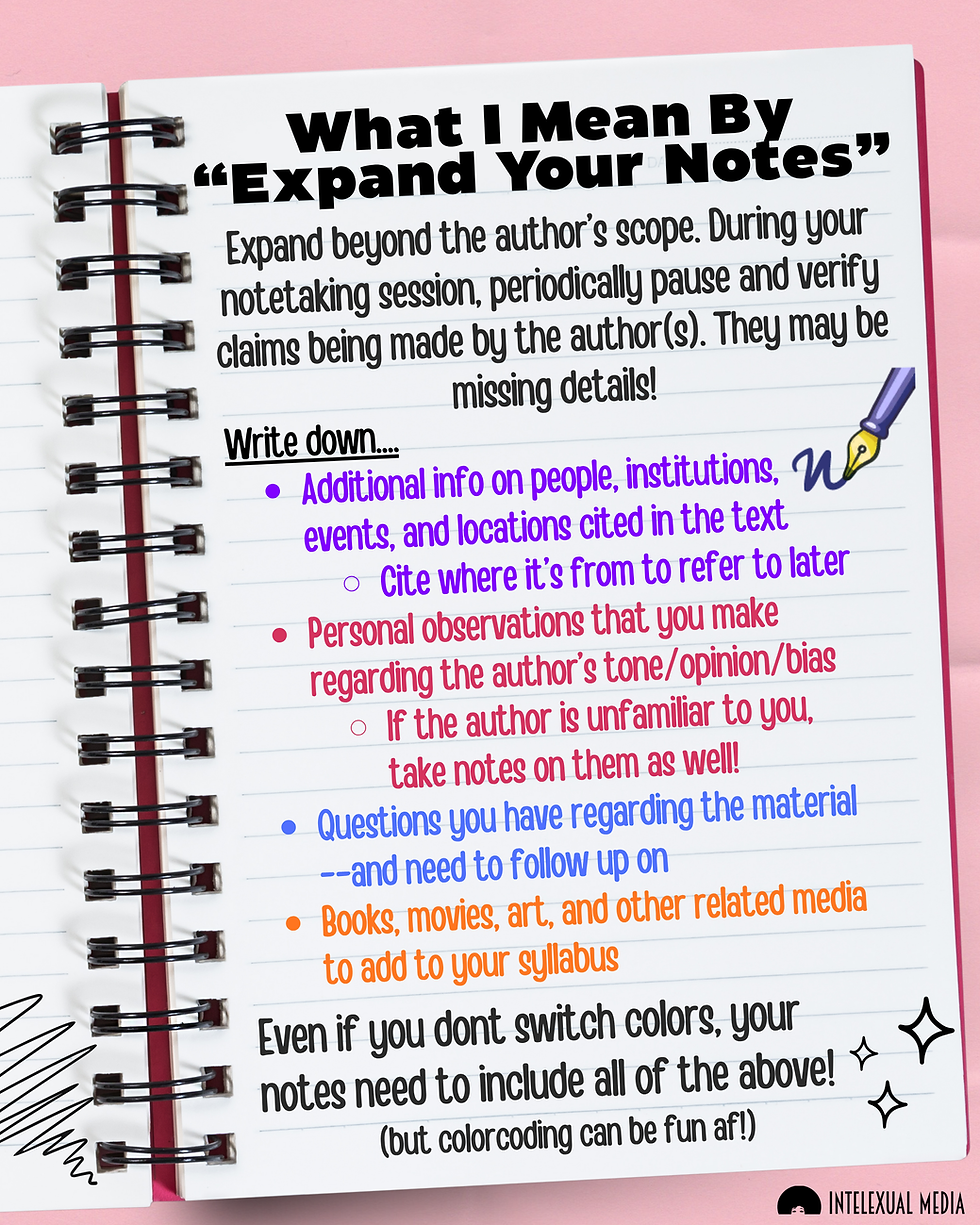
Your Notes Should NOT be Boring!
There are plenty of ways to entice yourself back into studying what you've written down. Make your notes sexy!

I Love Mindmaps!
Not only do these help you retain information, but they also help you plot how the information can be incorporated into your final project or analysis.

Bonus: Know How To Read Academic Papers!
These often expensive texts can be dense and packed with jargon.
Read the abstract to make sure it’s relevant before paying/downloading/printing/reading
Pay attention to methodology. It explains how the study/research was conducted. Analyze how this may be useful to your writing-- or a challenge. If this study has a small sample size, are there other studies with bigger ones? If this study has a specific racial group, are there studies with others?
Check for peer reviews. What are experts in the field saying about this research? Has anyone challenged it and accused it of being inaccurate? If so, why, and how does that fit into your understanding of the material?
The conclusion is the beef of the paper. Pay special focus to what the authors decided were important takeaways. Do they acknowledge unanswered questions that have potential research rabbit holes? If the paper is older, the authors may have followed it up with a book or update.
If you don't have the time to read the paper itself, check to see if there is news coverage of the study/paper so you can get summaries. Read multiple points of coverage and synthesize. This isn't a substitute for reading the paper, but helpful if you're a sophomore with a paper due tomorrow.
Finally, what are my personal must-haves for a successful study session?





This is a pretty good article.