


A Short History of Spooky Food
7 minutes ago
8 min read
As recently as 2021, Halloween was a $10.14 billion industry, with candy making up $3 billion of total sales. How did this happen? From ancient culinary traditions to cursed food and the commercialization of Halloween treats, how have spooky foods evolved? Sources are listed throughout and at the bottom of this post.
The Relationship Between Food and Death
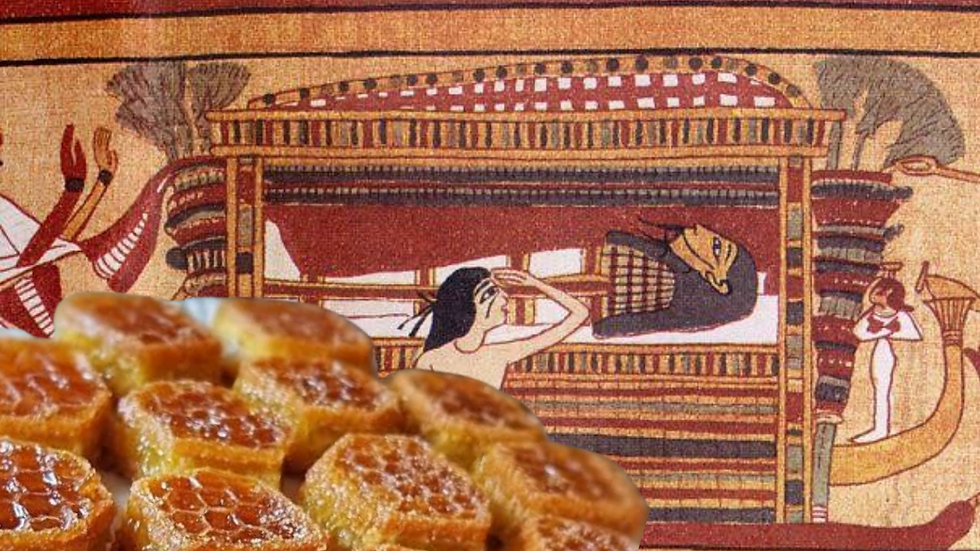
Of all the foods that can be placed on a grave, cakes are among the most popular. In Ancient Egypt, the dead were buried with honey cakes to enjoy in the afterlife. In the Netherlands, 'Doed Koeks', or dead cakes, were eaten by mourners at funerals. Wrote Tamra Andrews,
"People often made cake offerings to dieties to remove their evil influence. They also offered cake to spirits of the dead, believing that the cakes would nourish them during their long journey to the otherworld.... The Ainu people of Germany and Austria left cakes on graves, and the ancient Egyptians placed them inside tombs. Throughout Europe, people offered soul cakes to the dead to nourish them on their journey to the otherworld, or used cakes as offerings during funeral rights and feasts.... In Belgium, people believed that on this day, one soul was released from purgatory for every cake consumed."
Beyond cake, in England, Wales, Scotland, and North America, lower and middle-class mourners were described in 1790 as recipients of "funeral biscuits", a sweet treat in a "sheet of wax paper sealed with black wax." In early America, the funeral biscuits had motifs like skulls. When beekeepers died in Europe, wine and funeral biscuits were left by the apiary to please the bees and help them transition to a new beekeeper. The hives were lifted and set down at the same time of the coffin. This was part of a larger tradition of "Telling The Bees." This stemmed from ancient Aegean civilization beliefs that bees connected the mortal world to the afterlife. According to the Northern Star newspaper in 1838, if bees "are ignorant of [the dead], they become sick and many of them die." In Mexico, friends and family put food on altars and graves for Día de los Muertos.
Samhain Food Traditions

As discussed in a Black History of Halloween, the Celtic holiday was the precursor to Halloween. When the Catholic church forced the population to convert, the transition was made easier by retaining and tweaking established holidays. During Samhain, Celtic peoples left offerings of food and beverage to wandering spirits, or in some regions, faeries. They also engaged in 'mumming', or donning a disguise and performing in different homes in exchange for food and drink. Mummers would usually be offered colcannon, a mixture of mashed potatoes, chopped kale or cabbage, and onions. There was also apple cake, Barmbrack, apples, and nuts.

But picking apples or blackberries on Samhain was considered bad luck, because people believed the shapeshifting, chaotic spirit Puca spat on them. Some Irish people left Bubble & Squeak (also called Colcannon) out for Puca, which was made of mashed potatoes, cabbage or kale, butter, milk, and scallions. Additionally, the Irish feared that not smashing egg shells after eating them would allow a witch to sail around on the shells, find the eater, and curse them. Reginald Scot wrote in Discoverie of Witchcraft, published in 1584, "[Witches] can go in and out at anger holes, and sail in an eggshell, a cockle or mussel shell, through and under the tempestuous seas."
It is believed that the tradition of Jack-O-Lanterns originated with the Irish headhunting practice, in which enemy warriors were decapitated and collected for spiritual protection or divination. Eventually, turnips were used to carve faces, which protected the wearer from wandering spirits during Samhain.

It was common for young Irish people to gather and divine romance using food. For instance, if a girl ate an apple in a mirror while combing her hair at midnight, she could possibly see the reflection of her future husband. There was also Barmbrack, a speckled and dense yet moist fruit bread that included divining charms. The fruit was soaked in tea or whiskey, and the batter was spiced with cinnamon, nutmeg, ginger, and allspice. Each family member got a slice, with the following possibilities:
Piece of Cloth = Bad Luck
Button= You were staying single
Ring = Marriage within the year
Coin = Money
Pea = No Marriage
Stick= Marital/Romantic Strife
According to Brid Mahon,
"Almost all games and practices on this night had to do with love and courtship: the ring hidden in the colcannon or barm brack denoting marriage, or more disappointingly, the thimble foretelling spinsterhood. In many parts of the country the first and last spoonfuls of colcannon were put into the girl's stocking, which was then hung from a nail in the door in the belief that her future husband would be the first to enter."
Apples and nuts had long been associated with fortune telling, with Lesley Pratt Bannantyne explaining,
"Nuts have been used for magic since Roman times. Some Scottish and northern English people believed nuts were such powerful sorcerers that they called their October 31st celebration "Nut Crack Night"...Chestnuts and walnuts, both plentiful at harvesttime, were popular in early divination games. The most well-known game goes as follows: two nuts are named, each for a potential lover, and put on a grate in the fire. She who wants to know the future watches and waits. If a nut burns true and steady, it indicates the lover will have a faithful nature; if it pops in the heat, it indicates the man is not to be trusted."
From the medieval period onward, as Samhain gave way to All Soul's Day, Soul Cakes, or "small, round spiced biscuits marked with a cross" were given to 'soulers', people who traveled to different houses delivering prayers for the dead. Spices included cinnamon, nutmeg, allspice, and currants. The ingredients reflected wealth, with upper-class families adding saffron, rose water, and eggs. No matter the ingredients, it was believed that each soul cake given away freed a poor, suffering soul from purgatory. This tradition caught on in America, where an estimated six million Irish immigrants arrived in waves after 1820 due to the Irish Potato Famine.
Early American Halloween Food

The first mentions of Halloween in American media began in the 1870s. Pumpkins replaced turnips for Jack-O-Lanterns (which had caught on as a symbol of harvest season in general in the 1830s before its later association with Halloween). At Autumn Harvest Festivals or 'Play Parties, young Americans gathered to divine the future with games of Snap Apple, Nut Crack, and Dunking for Apples. In a game of Snap Apple, the fruit was attached to a stick or string with a lit candle on the end. Participants tried to bite the apple while dodging wax.
In the late 19th century, Soul Cakes were loosely replaced with cheese, pie, apples, and roasted and salted pumpkin seeds, and 'soulers' became trick-or-treaters in the 1920s. Thanks to the growing commercialization of Halloween in the early 1900s, trick-or-treaters expected homemade sweets, though some companies, like a New York-based factory in 1906, advertised "pure, wholesome, and good to eat candies" in the following varieties: Mexican, Vanilla, Strawberry Nut Kisses, Caramels, and Bon Bons. In 1935, a chain of grocery stores in Georgia offered 5-cent candy bars or 3 for 10-cents. In 1936, the "fanciest Fifth Avenue chocolates in a [2lb] gay Halloween box" were offered for $1 at Fred Meyer.
These types of pricey Halloween goodies were likely served at posh Halloween parties or given as gifts. In the 20s. Halloween was seen as a luxe foreign import, with some papers erasing its Irish roots to paint it as an affair from "the British Isles."

For average Americans in the 20s-40s, Halloween parties were a much more modest affair. A 1927 description of the Perfect Halloween Lunch in the Farmer's Guide Cookbook mentioned "meat sandwiches, dill pickles, doughnuts, sweet cider, pumpkin pie, raw apples, nuts." In Des Moines, Iowa in 1932, a housewife named Hazel Brown advised serving coffee, chicken celery salad, bacon sandwiches, mince pie a la mode, frankfurters, broiled steak with mushrooms, and Apricot and Cream Cheese Ball Gelatin Salad. Yum!
Housewives handed out treats to children to discourage pranks, but handing out individually wrapped candies to trick-or-treaters didn't really catch on until the 1950s, after the Great Depression of the 30s and the sugar rationing of the 1940s ended. Confectionery companies ramped up their Halloween advertising, like the following ads. You can view more mid-century ads here.
4. How We Got Candy Corn
This treat is a divisive icon of the Halloween season, but it didn't start that way. Candy Corn was invented in the 1880s by the Wunderle Candy Company, rebranded as "Chicken Feed" by Goelitz Confectionery in the 1890s, and became associated with Halloween after World War II. I'm not a fan, but some people go to war about this candy!
Modern Halloween and Spooky Food

The 1970s urban legend about razors in homemade Halloween treats coincided with the further rise of pre-packaged candy. Reported the Wall Street Journal in 1972, "The children and grandchildren of Mr. and Mrs. Ollamon H. Moore of Chicago returned from their Halloween trick-or-treating last year with a whole lot of goodies. And some not-so-goodies. When the Moores's son...bit into an apple, a concealed pin stabbed into the roof of his mouth. A ...granddaughter slashed her hands on razor blades hidden inside an apple. And another granddaughter who ate poisoned treats had to be rushed to the hospital to have her stomach pumped...Stories like these are changing Halloween in dozens of communities across this country. Some places are flatly banning trick-or-treating, others are sharply restricting the hours in which it's permitted, and still others are beefing up police and other security forces hoping to discourage child-haters. The true extent of the danger to children isn't known."
The legend evolved to include tampered pre-packaged candy. In the 1980s, Halloween celebrations dipped in the early 1980s, with candy sales dropping by 20-50% in 1982 alone. That same year, approximately 40 cities cancelled Halloween trick-or-treating and Kellogg's introduced a recipe for Jack O Lantern marshmallow treats. Though a 1985 study couldn't locate a single death or injury from Halloween candy, the myth was so pervasive that my own mother checked my candy hauls every year in the late 90s and early 2000s.
In 1984, McDonalds attempted a special Fall treat: Pumpkin Pie.

Also in 1984, Hormel introduced hot dogs stuffed with chili or cheese. It's a scary concept, so it fit perfectly for Halloween.

In 1986, Dunkin Donuts offered a collectible glass pumpkin jar with 12 sugar cookies for $25. McDonalds offered collectible ''Boo Buckets" with the purchase of Happy Meals.
Cute collectible novelties and food items (plus pop culture) further revitalized Halloween celebrations going into the 90s. There were Halloween Oreos, Hostess Scary Cakes, and a slew of breakfast cereals.
In the early 90s, Pepsi and Doritos coordinated to create two Halloween sweepstakes with specially marked bags of chips and bottles of soda, including collectible "monster money" or game pieces.
There was also the ‘Jumping Jack’ limited edition flavor, which Matt at DinosaurDracula described as "Blending a monterey jack cheese flavor with all sorts of colorful spices, "Blending a monterey jack cheese flavor with all sorts of colorful spices." Prizes varied from a discount coupon to a “chance” at a $1 million jackpot paid over 20 years.
In 1993, General Mills introduced Pillsbury cookie-in-a-cookie featuring ghosts and pumpkins, and Brach's candy introduced 'Dem Bones'.
In the late 90s, Kid Cuisine rolled out Halloween-themed frozen meals, continuing the tradition of commercial spooky foods.
In 2001, Burger King collaborated with The Simpsons Treehouse of Horror to deliver spooky collectible toys with each Big Kids Meal.
For the bold, there was the Scary Black Cherry or Outrageous Orange drink, which turned your tongue black or orange.
In 2003, Starbucks unveiled a flavor that became associated with Halloween and Autumn: the Pumpkin Spice Latte. Though the blend of cinnamon, allspice, cloves, and ginger had long been used for pumpkin pies, it became routine in a slew of other products from creamer to cream cheese.

In 2003, Wendy’s began selling Boo Books Coupons for low-priced Frosties. The books have earned nearly $40 million for the Dave Thomas Foundation for Adoption.

Cheetos Bag of Bones chips were another one of many Halloween-themed snacks. These were introduced in 2014.

Get More Halloween History on the Intelexual Media YouTube channel!
Sources & Further Reading
Special shoutout to the Dinosour Dracula blog!
https://www.cnn.com/2021/10/31/us/halloween-food-candy-history-apple-peels-cec
https://snackstack.net/2022/10/26/a-timeline-of-halloween-treats/
https://www.jstor.org/stable/2078795?mag=halloween-a-mystic-and-eerie-significance&seq=1
https://www.smithsonianmag.com/smart-news/candy-corn-hasnt-changed-19th-century-180957107/
https://www.spectatornews.com/uncategorized/2007/10/history-of-candy-corn/
https://www.smithsonianmag.com/smart-news/candy-corn-hasnt-changed-19th-century-180957107/


Comments