


Where Hotties Study History (Pt 2)
May 18
3 min read
The fun in studying history is the treasure hunt for knowledge! Here's another short guide to enhance your skills.
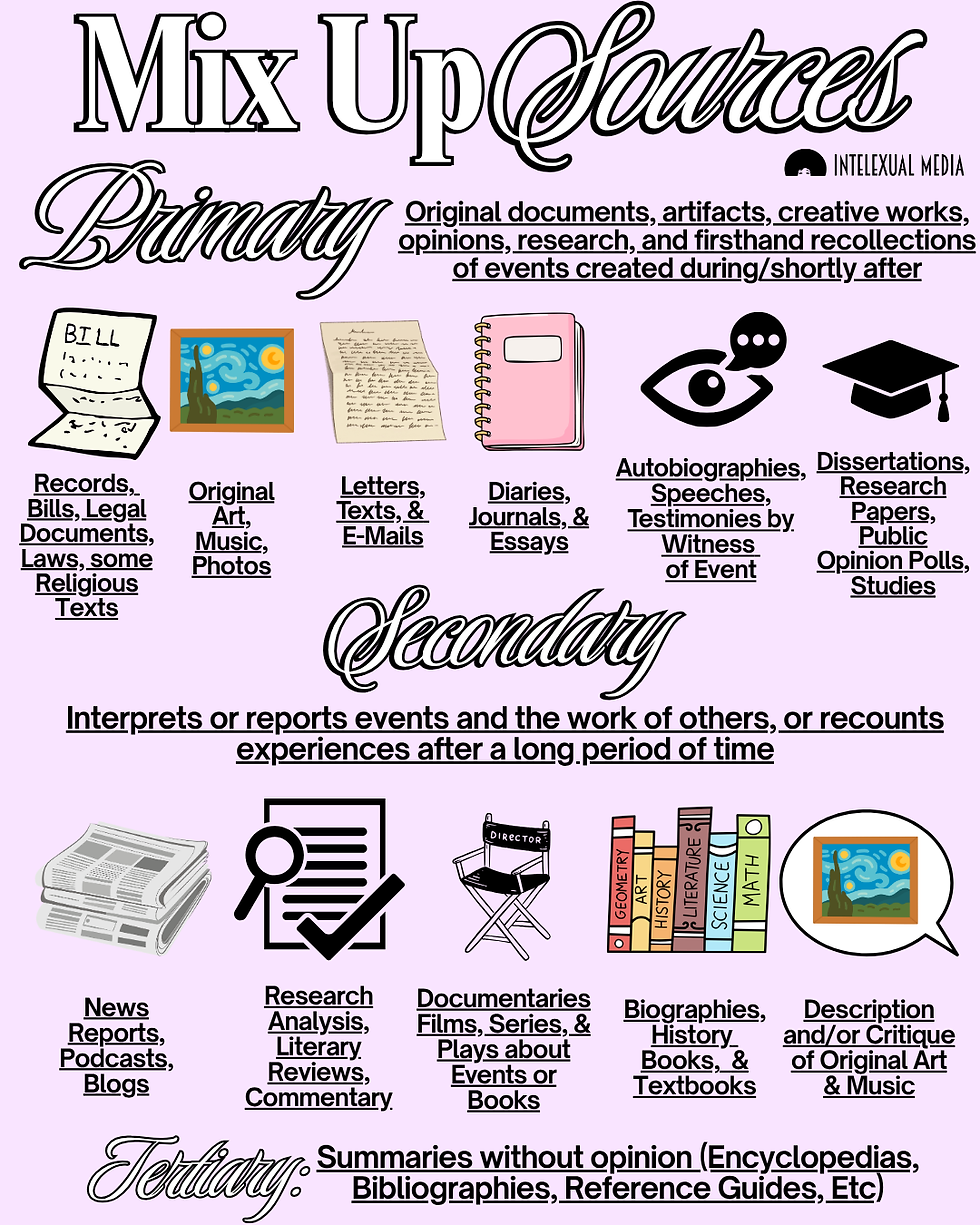
Mix Up Your Sources
Sources can be interpreted in different ways and can change depending on the discipline utilizing them, but in general, the following graphic outlines primary versus secondary sources. Using a combination of these will only improve your understanding of the material, help you synthesize data, and polish your final analysis.
Search With Intention!

Search engines aren't as helpful as they used to be, so its important to know how to navigate with intention.
On general search engines, look for books, paper titles, authors, and subject keywords with the words: “pdf”, “syllabus”, “critique”, “research”, “collection”, “memorial”, “digital archive”, “academia”, “report”, “historiography”, “sociology”, and “analysis.”
Search topics with multiple dates -- I’ve found that more concentrated time periods yield more rare results
For example, instead of looking for a topic with an ‘anytime’ filter, narrow down to “1999-2004”, “January 26-April 21st”, etc
Keep an evolving list of keywords that match your research to plug into:
Fresh database websites
Lengthy dissertations/journals/pdfs that are beyond the scope of your project
Reference Book Indexes
Always scan a work’s bibliography
Steal relevant readings, viewings, and oral history interviews from university syllabi. Just be sure to vet professors and institutions!
Tap Into Libraries
Use your FREE library card to:
Borrow non-fiction books, magazines, audiobooks, and documentaries
Request books you don’t want to buy
Scan and study microfilm
Take classes and learn new skills
Meet with touring intellectuals and authors
Explore special collections and genealogy archives at unique locations
Use digitizing technology for your personal archive
Additionally, talk to librarians about your research needs! They love to help and know how to harness esoteric taxpayer resources for your projects.
Get Familiar With Archives
Major research institutions have digitized archives that can provide excellent regional history lessons and scholarly resources.
College Websites (ex. UNC Chapel Hill Enslaved Narratives and Howard University's Hilltop Newspaper)
Museum Websites (ex. National Museum of African American History and Culture)
Historical Society Websites (ex. Afro-American Historical and Genealogical Society)
City & State History Websites
Library of Congress
Check out state and federal archive locations for in-person services and collections
Many journalists and historians archive their own work on their websites and social media pages. I’ve found out-of-print essays and magazine scans on personal blogs!
Newspaper, Zine, and Magazine Archives offer free and discounted access
More Free Resources
Plug all paid articles into paywall removal websites
Wikipedia Footnotes, Wikipedia Commons, Wikibooks, WikiQuote, WikiSource, WikiData
PrintFriendly for turning webpages into printable files with no ads/photos
TVTrope.org is filled with not just folklore but linked references to academic sites and writers
Project Gutenberg has over 75,000 free e-books
When To Spend Money
Individual newspaper archive subscriptions (and bundle sites like newspapers.com) are endlessly invaluable. JSTOR is also an important go-to for me and my research.
Sometimes you really do need to shell out money for emerging non-fiction titles from academics in your field if the project is urgent. But if you have time, before you commit to brand new editions, search for cheap academic textbooks at used bookstores (because college students carelessly got rid of them after a single semester). Also check thriftbooks.com
Used bookstores in your area may have vintage magazines, maps, letters, photos, vinyls, DVDs, and ephemera for cheap. Explore!
Example: if you’re in Atlanta, try Atlanta Vintage Books!
Choosing Books
If you have limited time or budget, it's important to choose the right books for your research-- though collecting an array of the following books is important to building a proper research library!

Bonus Tips
Curate your socials. Follow historians and journalists of relevant topics so you know about new research, breakthroughs, publications, and discourse
Set up alerts on your browser for up-to-date publications of news stories and academic papers that matter to your research (Track authors too!)
Keep an organized document of your favorite areas of study with archives, historians, books, and websites listed for each. The bigger your collection, the more organized it will need to be!
When looking for old videos on YouTube, type in the topic and year with “retro footage”, “archival footage”, and “news report.”
Visit museums, talk to elders, watch old news reports, conduct interviews, attend free lectures, and be curious about the world around you. Accept free papers and zines!
Things disappear! Do your part to fight the loss of media by screenshotting, printing, and preserving what you find! ArchiveWeb.Page is a great Google Chrome extension for this
Are you working on any research projects right now? If so, I hope these tips were helpful!


Comments