


Black America Rewind: 1940s
Jan 9
12 min read
Updated: Feb 9
Our history will not be erased. In this near-weekly series, we'll focus on important Black American history from the 1920s to the 1990s. Full posts are available here, but you can follow along with the abridged versions on Instagram, too.

The 1940s witnessed significant changes in the circumstances of Black Americans during World War II. White people reacted with vengeance and violence to Black Americans' improved quality of life, setting the stage for the development of the eventual Civil Rights Movement.
1940s Ripple Effects

Important 1940s Black American Events
Integrating The Military
Before World War II, approximately 3,640 black men served in four units of the army and on the galley of naval ships. They were banned from the Marines & Air Force.
In September 1940, A. Phillip Randolph and Walter White presented a 7-point program on getting Black people involved in war mobilization, including integration. President Franklin Delano Roosevelt refused.
Facing an angry Black bloc of voters (and A. Phillip Randolph's threat of a march on Washington), FDR made concessions like creating the Tuskegee Airmen and ordering the Navy and Marines to accept black men in segregated units
The 1940 Selective Service Act drafted servicemen “without regard to race,” thanks to the Committee For The Participation of Negroes In National Defense
Harry Truman’s Executive Order 9981 desegregated the armed forces but it took years to successfully implement, as rogue facets of the military refused to comply.
World War II
Approximately 1.2 million Black people served in the military during WWII. In their roles of combat and support, fewer than 800 died.
Black soldiers often navigated racism in Southern towns during training camps.
The Tuskegee Airmen were the first Black pilots in the U.S. Armed Forces
They were led by Benjamin O. Davis Jr., who became the 1st Black General in the Air Force
They flew over 1500 missions and shot down over 400 enemy aircraft
Roughly 1,700 Black soldiers stormed the beaches of Normandy on D-Day, which laid the groundwork for the liberation of France and the eventual fall of the Axis powers
After the war ended in Europe on May 8, 1945, thousands of Black soldiers remained in Germany, where they found that some local communities were more hospitable than the American South
The children that the soldiers had with German women were called ‘mischlingskinder’
Because Nazi Germany was a primary enemy of the United States, America wished to not appear hypocritical and posit itself as a "good" and "just" champion of human rights. Reports of eugenics and racism undermined this propaganda, so the federal government begrudgingly made small attempts to improve the lives of Black Americans (atleast on the surface).
The Negro Soldier
Hollywood director Frank Capra was tapped by the US government to create a propaganda film to boost Black American morale
As explored by Thomas Cripps and David Culbert in The Negro Soldier (1944): Film Propanganda in Black and White, Capra consulted sociologists on how to make the film as impactful as possible. They wrote,
"Sociologist Donald Young, who had devoted his pre-war career to the study of racial minorities and the impact of motion pictures, prepared a memorandum filled with well-meaning cautions, the ideas of a liberal who above all sought racial tolerance: avoid stereotypes such as the Negroes' alleged affinity for watermelon or pork; also avoid strong images of racial identity ("play down colored soldiers most Negroid in appearance" and omit "Lincoln, emancipation, or any race leaders or friends of the Negro"). Young also favored intraracial politesse: "Show colored officers in command of troops, but don't play them up too much. The Negro masses have learned that colored men who get commissions tend to look down on the masses."
The success of The Negro Soldier showed Black American leaders how important film was in the propaganda machines (and the battle for Civil Rights). The movie led to more roles of dignity for Black Americans in Hollywood films, as before they were often limited to comedic roles with little substance or roles depicting them as subservient.

It cannot be understated how important the GI Bill was to improving the lives of White Americans, who went to school for cheap, started businesses, and bought cheap homes that led to generational wealth for their offspring. If Black Americans had been given the benefits they were owed, the wealth gap of today may not be as wide.

1940s Quick Facts & Cost of Living
Black population by 1950: 15,042,286 (9.98% percent of the U.S.)
National Birth Rate (1947): 25.8 per 1000 women
Black Female Marriage Rate by Age 40-43: 92%
National Divorce Rate (1947): 3.4 per 1000 marriages
Interracial Marriage Rate: Less than 1% of unions
Median Annual Income (1946):
White men: $2,678
White women: $1,710
Black men: $1,715
Black women: $928
Common Jobs: War production manufacturing, military service, sharecroppers, maids, caregivers, manual laborers, educators, beauticians, barbers, local retailers

Important 1940s Ideas
The Double V Campaign

During WWI, Black leaders advised the community to be patriotic and put racial activism and concerns on hold
In 1942, James G. Thompson wrote a letter to the Pittsburgh Courier titled, Should I Sacrifice To Live Half American. He discussed his trepidation about serving a racist country, writing,
"Being an American of dark complexion and some 26 years, these questions flash through my mind: ‘Should I sacrifice my life to live half American?’ ‘Will things be better for the next generation in the peace to follow?’ ‘Would it be demanding too much to demand full citizenship rights in exchange for the sacrificing of my life? Is the kind of America I know worth defending? Will America be a true and pure democracy after this war? Will Colored Americans suffer still the indignities that have been heaped upon them in the past? These and other questions need answering; I want to know, and I believe every colored American, who is thinking, wants to know. This may be the wrong time to broach such subjects, but haven’t all good things obtained by men been secured through sacrifice during just such times of strife." - James G. Thompson
The Courier launched the Double Victory campaign, encouraging Black Americans to support war efforts abroad but also to fight poll taxes, disenfranchisement, and discrimination at home
The campaign caught on nationwide, with DV merchandise, clubs, and parties
Dignity
After serving their country abroad, returning soldiers had become accustomed to dignity and respect and wanted the same treatment at home. They would not accept Jim Crow and legalized racism much longer.
Identifying & Targeting Sexual Violence Against Black Women

On September 3, 1944, in Abbeville, Alabama, 24-year-old wife and mother Recy Raylor was gang raped by 7 white men after being abducted on her way home from church. When one of the rapists, Hugo Wilson, was identified by his car, he admitted to the rape and named his fellow perpetrators. Police never arrested the men or conducted a line-up. Recy was falsely accused of being a sex worker and faced intimidation, threats, and her home was bombed. 2 attempts to indict the rapists failed. Though Recy did not receive the justice she deserved, the event galvanized the Civil Rights movement, especially thanks to the organizing work of Rosa Parks, who created the Committee For Equal Justice for Mrs. Recy Taylor. Recy was the most high-profile case of the era (though still underdiscussed). Another case was Viola White, who refused to give up her seat on a bus in Montgomery, Alabama in 1944. When arrested and fined $10, she appealed her conviction and was threatened by the city's elite. Viola's 16-year-old daughter was raped by a police officer in retaliation.

1940s Racism Tracker
Race Riots of 1943
In the aftermath of Executive Order 8802 being implemented in the defense industry, changing city demographics, strained public services, and. old-fashioned racism led to riots and violent behavior in multiple American cities-- particularly in 1943.
Detroit, Michigan

Prime World War II factory jobs caused the population to soar. The population grew from 1.6 million in 1941 to nearly 2 million in 1943. Black Americans were forced into small sections of the city, like Black Bottom and were required to pay 2-3 times the average rent. They only had access to one public housing project, the Brewster Housing.
Whites led work strikes when black people were promoted. For instance, when the Packard Motor Car Company promoted three black people to the assembly lines of their factory in June, 25,000 white workers walked off the job.
On June 20, Black and white youth clashed and fought on Belle Isle. Rumors spread that a black woman and her baby had been killed and a white woman had been raped. Violence spreads as 100,000 people leave the island through the Belle Isle Bridge.
Both groups rioted, but only black people were targeted by the police
9 white people killed, and 25 Black people killed (17 were killed by police)
675 people were injured, and $2 million in damages were caused
Black people begged the mayor and governor to call in the state military, and over 3500 troops arrived to restore order.
Black leaders were infuriated that white people were allowed to act violently with impunity. The president of the Detroit branch of the NAACP, Dr. James J McClendon, wrote, “We do not condone the acts of hoodlums of our race any more than you condone those who overturned cars, ran down the defenseless and enacted other acts of violence on Woodward Avenue. Had more police been stationed on Woodward Avenue rather than concentrated throughout the Negro area, there would not have formed such a gigantic mob of 10,000."
On June 24, 1943, in Bamber Bridge, Lancashire, United Kingdom, black GI's (many of them from Detroit) were hassled by white military police while hanging out at a pub. British soldiers witnessed the harassment and supported the Black soldiers. Private William Crossland was murdered by one of the military police. Believing they were under attack (and hearing rumors that MPs would shoot and kill them at random) the Black GI's fled back to base, stole weapons, and went to go find the MPs. A gun fight ensued, and one more person was killed. 32 black soldiers were charged with mutiny and related charges, while the military police faced no consequences.
Mobile Alabama Riot

Black welders began working at the Alabama Dry Dock and Shipping Company on May 24, 1943
The next day, between 500 and 1000 white men began attacking black workers
The Alabama State Guard was called in and restored order by June 5
Beaumont Texas Riot

Like in Detroit, WWII factory jobs increased the city’s population and strained public resources. The population had grown from 59,000 to 80,000 between 1940 and 1943. The Ku Klux Klan's planned a big rally before the riot, and the Black community was preparing for the annual Juneteenth celebrations
On June 15, the white daughter of a Pennsylvania Shipyard worker accused a Black man of rape. 2,000 white workers walk off the job and are joined by 2,000 additional white men. They attack black neighborhoods and people, destroying 100 homes. 1 white man and 1 black man were killed, with over 200 people injured
The Texas military was called to intervene, and martial law was in place until June 20
Moore's Ford Lynchings (1946)

In 1946, WWII veteran George W. Dorsey and his wife, Mae, along with his sister Dorothy and her husband, Roger Malcolm, were hired as sharecroppers in Walton County, GA
After Malcolm was arrested for allegedly stabbing a white man, their boss, J. Loy Harrison, posted his $600 bond and drove the couples back towards his farm on July 7, 1946.
The car was stopped by 15-20 unmasked white men, and all four were shot and killed. J. Loy Harrison was left alive and claimed not to know any of the white men
Despite protests, marches, national news coverage, and a $10,000 reward offer from Governor Ellis Arnall, nobody was ever charged
3x elected governor Eugene Talmadge, an ardent racist and candidate for governor in the 1946 election, likely sanctioned the killings. He was overheard telling whiite people that he would offer immunity to anyone who "took care" of Roger Malcolm. As for J. Loy Harrison, he remains under suspicion as a co-conspirator
.
As a result of the lynching, the entertainer Paul Robeson founded the American Crusade Against Lynching. Robeson and other members (like famous genius Albert Einstein) demanded that Harry Truman denounce lynching
The ACAL was considered a communist front by the FBI and it's members were put under surveillance.
Paul Robeson's outspoken nature led to the media dubbing him a traitor
In 1949, Jackie Robinson, who was friendly with Robeson, was summoned to testify about Robeson and to alienate him politically. We return to Paul Robeson in the 1950s.
"We in America do not forget that it was on the backs of the white workers from Europe and on the backs of millions of Blacks that the wealth of America was built. And we are resolved to share it equally. We reject any hysterical raving that urges us to make war on anyone. Our will to fight for peace is strong. We shall not make war on anyone. We shall not make war on the Soviet Union. We oppose those who wish to build up imperialist Germany and to establish fascism in Greece. We wish peace with Franco's Spain despite her fascism. We shall support peace and friendship among all nations, with Soviet Russia and the people's Republics." --Paul Robeson (4/20/49)


1940s Black Education Fast Facts

By 1940, 85% of Black people over the age of 10 could read
Black children often received less time in school than white ones (about 5-6 months of the year), because they often needed to work to plant crops in April and May and harvest crops in September and October
Children born in 1945 were the 1st group in which Black and whites attended about the same amount of school
Charles Houston and NAACP attorneys spent the decade collecting photographic evidence of poor learning conditions in the rural South, which would be used in Brown v Board of Education
Less than 5% of all adults completed a 4-year degree in the 1940s-- for Black Americans it was approximately 1.3%
Black women more likely to go to and finish college
Approximately 11.5% of Black Americans had some college education in 1940
In 1940, 56.9% of Black female college grads and 35.9% of male college grads worked as teachers (one of the few professional occupations available to them
Only 7-7.7% of Black people had a high school diploma, versus 24% nationally.
The Association of Colleges and Secondary Schools for Negroes and the General Education Board conducted a study of 17 black high schools in the Secondary School Study to assess and hypothesize what a progressive education would look like.
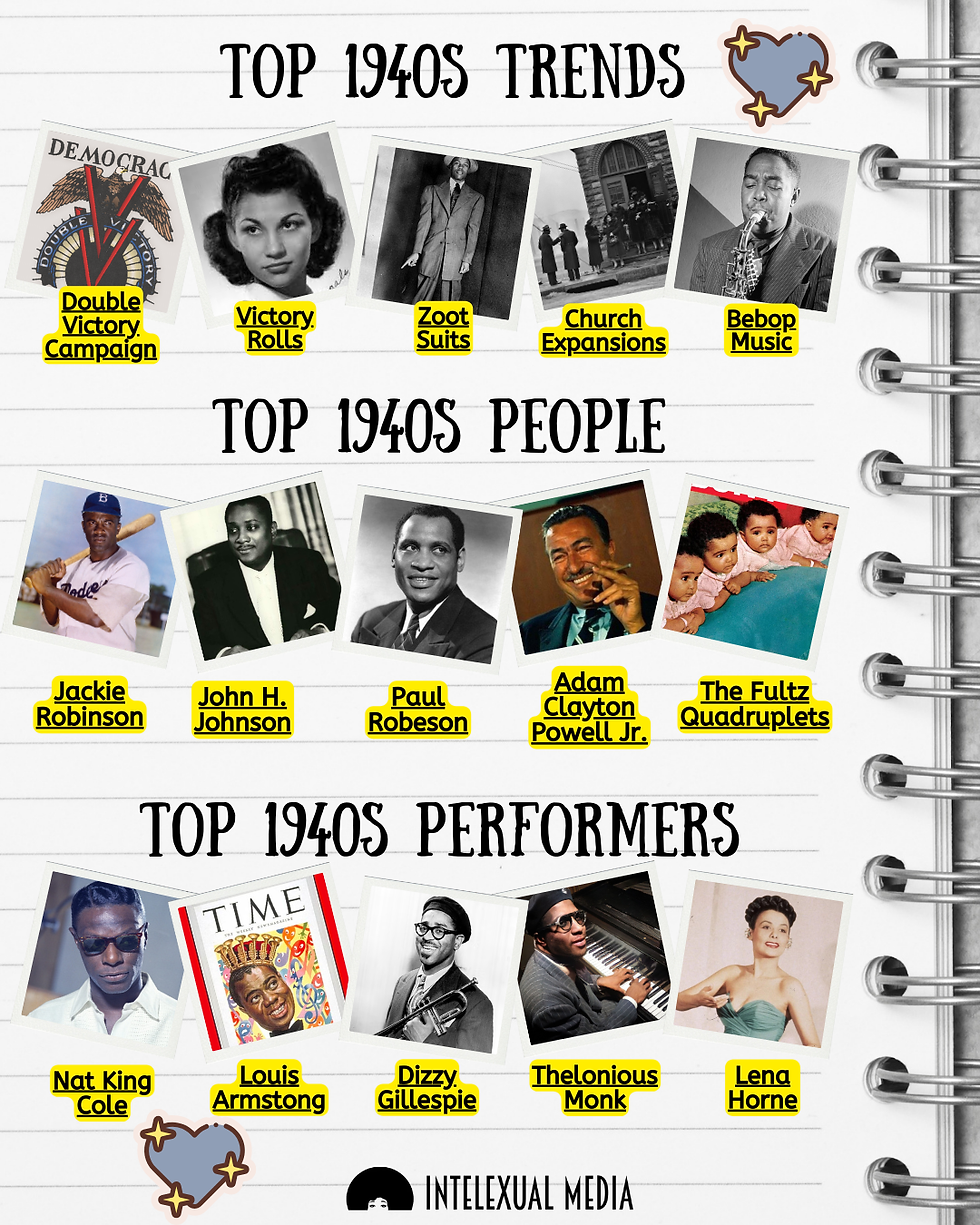
Top 1940s Trends, People, & Performers

1940s Figure Spotlight: Rosa Parks

Born in 1913 in Tuskegee, Alabama, Rosa Parks came of age under the violence of Jim Crow. As a 6 or 7-year-old, she worked on a plantation picking cotton for 50 cents a day. By age 12 she was enrolled in school, and though she intended to become a teacher, she had to eventually drop out to help her family. Her marriage to activist Raymond Parks at the age of 19 facilitated her own activism, like helping with the Scottsboro Boys in 1933. She initially wasn't interested in him (partly because of his light skin) but he had a car.
With Raymond's encouragement, Rosa returned to school for her diploma and later became a nurse, eventually working at an Air Force Base in 1941 where she first experienced integrated public services. Rosa joined the NAACP in 1943 and became the secretary. The following year, she investigated the rape of Recy Taylor and created an advocacy group for her. It was foundational to the Civil Rights Movement. In the time leading up to her famous act of refusing to give up her bus seat in 1955, Rosa was trained in the art of civil disobedience, eventually becoming a Civil Rights hero in the 50s and beyond.
1940s Figure Spotlight: Benjamin J Davis

Born in 1903 in Dawson, Georgia, Davis grew up to be a lawyer and communist elected to the New York City Council in 1943, representing Harlem. He filled Adam Clayton Powell Jr.'s vacated seat, as he was now serving in Congress. By the time Davis was re-elected to a 4-year term in 1945, communism's relative influence was waning. The added failure of the USSR to adhere to commitments made during the Yalta Conference at the end of the war (sparking the Cold War) further soured views on capitalism. FBI director J. Edgar Hoover began aggressively investigating the Communist Party of the United States in July 1945. Twelve CPUSA members, including Benjamin J Davis, were arrested for violating the Smith Act, which was passed in 1940 and made advocating for the overthrow of the US government illegal.
The trial for 11 of the members began on November 1st, 1948 and lasted until October 14, 1949 making it the longest federal trial in history at that point. Ten members, including Davis, were found guilty and given five years of prison and a $10K fine. One member was given three years because of his status as a World War II veteran. Shortly after Davis was arrested, the New York City Council voted to remove him from office. After prison (and serving an additional 60-day term for contempt of court in Pittsburgh), Davis cotuued to be a politically active public speaker and advocate for Civil Rights.
1940s Black Artists

Do you want to conduct your own research on the Black 1940s? Check out this list from A-Z for inspiration!

Check out Intelexual Media Guides for details on how to do your own research.
In Black America Rewind: 1950s, we'll discuss:
The Impact of War II
The Double V Campaign
& More!


Comments