


Black America Rewind: 1960s
Feb 24
26 min read
Updated: Feb 26
Our history will not be erased. In this near-weekly series, we'll focus on important Black American history from the 1920s to the 1990s. Full posts are available here, but you can follow along with the abridged versions on Instagram, too.

The 1960s are arguably one of the most turbulent and consequential decades in American history. Despite the Vietnam War, numerous political assassinations, the intimidation of COINTELPRO, violent terrorism, and the continuation of American-As-Apple-Pie racism, Black Americans forged ahead to accomplish new achievements in politics, culture, and education that scores of us would benefit from in the future.
1960s Ripple Effects
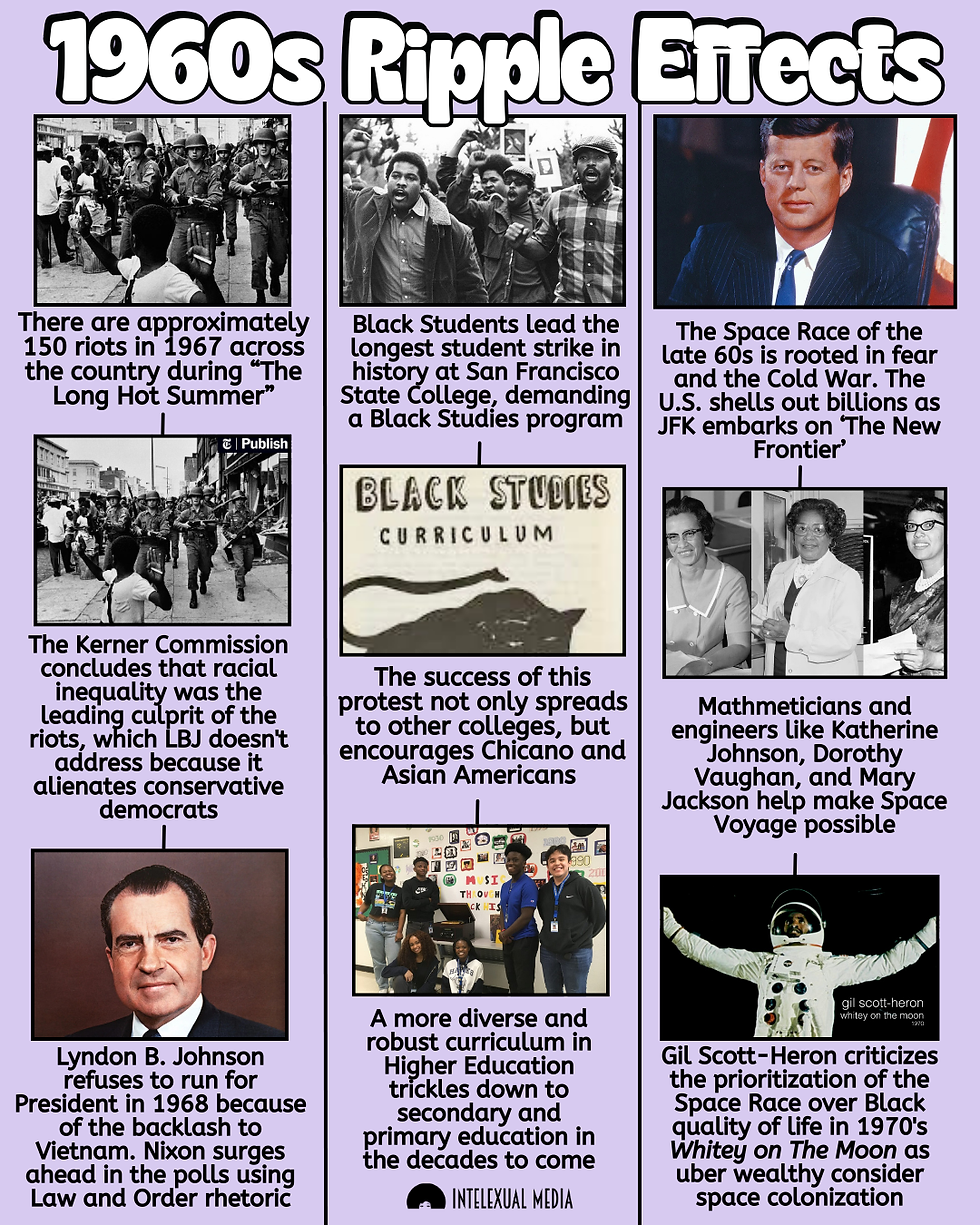
Important 1960s Events
Freedom Rides (1961)

Intending to test 1960's Boynton v. Virginia, on May 4th, 13 members of the Congress of Racial Equality (CORE) traveled on an integrated bus from D.C., intending to go to New Orleans.
They were attacked by white mobs in Alabama (protected by Commissioner of Public Safety Bull Connor) and had to stop on May 17th.
On the same day, another Freedom Ride of members of the Nashville Student Non-Violent Coordinating Committee began.
This batch of riders was attacked in Montgomery, where protesters (including future congressman John Lewis) were beaten nearly to death.
President John F. Kennedy ordered US Marshals to the area on May 21st
That same day, supporters, Southern Christian Leadership Conference members, and Martin Luther King Jr. gathered at First Baptist Church, where a white mob threw rocks at the windows and set cars on fire
Freedom Rides netted federal involvement and encouraged Black leaders to support Direct Action. There were a slew of protests (many unreported) across the South.
Moderate white Americans were pushed into an uncomfortable space as they witnessed mob violence
Atleast 436 people participated in 60 Freedom Rides
On November 1, 1961, the Interstate Commerce Commission issued desegregation rules on travel, allowing American citizens to sit wherever they wanted on any transportation they paid for

The JFK Assassination (1963) & The Johnson Presidency (1963-1969)

While it is not specifically Black history, the assassination of the 35th President had tremendous effects on the community. The progressive yet flawed Lyndon B. Johnson was more willing to act on the basic needs of Black Americans, particularly:
Civil Rights Act of 1964
Economic Opportunity Act of 1964
Medicare and Medicaid
Appointing the first Black person to a cabinet position (Robert Weaver to the Department of Housing and Urban Development in 1966)
Appointing the first Black female judge to a district court, Constance Baker Motley, on January 26th 1966
Nominating the first Black Supreme Court Judge, Thurgood Marshall, in 1967
Civil Rights Act and Federal Housing Act of 1968

Johnson's status as a democrat while he carried out such legislation further solidified Black loyalty to the party (and drove out more Southern racist whites). Johnson, a Texas-born former senator who spent his early days in Congress impeding civil rights, had changed. The quote he's most known for (and which is taken out of context) spoke to his realization that racism was a scam: "I'll tell you what's at the bottom of [the racist signs he passed in Tennessee]: if you can convince the lowest white man he's better than the best colored man, he won't notice you're picking his pocket. Hell, give him somebody to look down on, and he'll empty his pockets for you."
The Vietnam War (1955-1975)
Johnson's presidency came with a price: Vietnam. While Dwight Eisenhower had started the war (by installing a Catholic anti-communist as leader of South Vietnam, stimulating a civil war with the North), and JFK played a big role in exacerbating it (by sending thousands of military advisors and millions of dollars in weapons and equipment to South Vietnam), Johnson made it his personal mission not to 'lose' Vietnam to the communists, escalating the conflict to the costly and violent saga that impacted America for decades to come.

By the end of 1964, there were 23,000 US military personnel in Vietnam. By the end of 1965, there were 184,000. During this time, being anti-war was an EXTREMELY radical position for a person or entity to take. Most liberal and conservative Black leaders shied away from criticizing the war because to do so would garner accusations of being a communist. But the sheer brutality of the US's weapons, the likelihood of the poor being drafted ('The Poverty Draft'), and the mounting losses and scandals made people speak up, like Martin Luther King Jr. in 1967. From 1967 to 1975, the National Security Agency (which many Americans didn't even know existed) stalked and tracked anti-war activists for Project MINARET under Johnson's orders. The next year, over 500,000 military members were in Vietnam, and hundreds of thousands more in Thailand, Japan, Laos, and other Asian countries in the name of 'fighting communism.' This was a turning point in public perception of Vietnam, as the war was costly, and America was losing terribly. As the body count rose, Johnson decided not to run again in 1968. General distaste for the Democrat-accelerated war, protests, radical Black people, crime, and riots (along with the assassination of the Democratic front-runner Robert Kennedy) paved the way for a Richard Nixon victory.
The Birmingham Crisis (1963)

In April 1963, ‘Project Confrontation’ began in Birmingham, AL, with a series of marches and protests
White supporters and moderates in the movement were hesitant and suggested pausing the protests
On April 7 (Pam Sunday), Martin Luther King's brother A.D. King and two others led 1000 people on a march from St. Paul United Methodist Church to Birmingham's City Hall
On Commissioner of Public Safety Bull Connor's command, they were followed by police and dogs and arrested en masse
On April 12 (Good Friday), MLK and at least 55 other people were arrested for "parading without a permit" and thrown into jail for 8 days
During his incarceration, he wrote Letter From a Birmingham Jail on smuggled paper
"We know through painful experience that freedom is never voluntarily given by the oppressor; it must be demanded by the oppressed. Frankly, I have yet to engage in a direct action campaign that was "well timed" in the view of those who have not suffered unduly from the disease of segregation. For years now I have heard the word "Wait!" It rings in the ear of every Negro with piercing familiarity. This "Wait" has almost always meant "Never." We must come to see, with one of our distinguished jurists, that "justice too long delayed is justice denied." We have waited for more than 340 years for our constitutional and God given rights. The nations of Asia and Africa are moving with jetlike speed toward gaining political independence, but we still creep at horse and buggy pace toward gaining a cup of coffee at a lunch counter. Perhaps it is easy for those who have never felt the stinging darts of segregation to say, "Wait." But when you have seen vicious mobs lynch your mothers and fathers at will and drown your sisters and brothers at whim; when you have seen hate filled policemen curse, kick and even kill your black brothers and sisters; when you see the vast majority of your twenty million Negro brothers smothering in an airtight cage of poverty in the midst of an affluent society; when you suddenly find your tongue twisted and your speech stammering as you seek to explain to your six year old daughter why she can't go to the public amusement park that has just been advertised on television, and see tears welling up in her eyes when she is told that Funtown is closed to colored children..." -- Martin Luther King Jr., Letter From a Birmingham Jail
From May 2 to May 10, over 1,000 Black children and teenagers, organized by SCLC leader and Reverend James Bevel, marched through Birmingham on the Children's Crusade

They were arrested and released, and often returned the following day to be released again
Bull Connor authorized the use of dogs and high-pressure water hoses on the children
The extremely negative media attention led to a May 9th agreement of downtown businesses to segregate, hire Black people, and to release jailed protesters
On June 11, Alabama Governor George Wallace stood in the way of Vivian Malone and James Hood when they attempted to enter the University of Alabama to enroll in classes.

Wallace's infamous Stand in The Schoolhouse Door When Wallace was inaugurated earlier in the year, he said, segregation now, segregation tomorrow, and segregation forever!"
JFK federalized the state's National Guard, allowing Malone and Hood to attend school
Also on June 11, President John F Kennedy announced he was sending a Civil Rights bill to Congress. Mississippi NAACP Field Secretary Medgar Evers was assassinated the next day.
At least 758 protests in 186 cities followed the Birmingham Crisis within 10 weeks. By the end of the year, there had been over 20,000 arrests, at least 35 bombings, and 10 deaths directly tied to the protests
The March on Washington For Jobs and Freedom (1963)

Over 250,000 people were bused in for the March on Washington (August 28th), where MLK delivered his iconic I Have a Dream speech
Plenty of people were critical of the event and speech, with Malcolm X calling it the "Farce on Washington', saying, "Whoever heard of angry revolutionaries swinging their bare feet together with their oppressor in lily-pad park pools with gospels and guitars and 'I Have a Dream' speeches?
While everything seemed bright and optimistic, the murder of four black girls while they were at church followed in September, and future political assassinations would rock the Black community
Freedom Summer (1964)

Only 6.2% of Mississippi’s eligible Black voters were registered in the early 60s.
In 1961, Bob Moses, Charles Sherrod, and future mayor Marion Barry embarked on the Mississippi Project, traveling to the state to establish clinics and freedom schools to register people to vote.
Their target areas were Amite and Pike Counties. In Amite, only 1 Black person out of 5500 were registered
This was the foundation of the bigger effort of Freedom Summer in 1964
Various groups in the Council of Federated Organizations (COFO) were trained to send people South to register Black Mississippians to vote.
White college students were recruited from across the country
There were over 35 shootings, 30 property bombings, 35 church arsons/bombings, 80 assaults, and 6 murders
Bloody Sunday (1965)

In Selma, Alabama, half of the city's residents were Black, but less than 2% of eligible voters had been allowed to register
On February 18, 1965, activist Jimmie Lee Jackson was beaten and shot to death by state troopers during a peaceful protest
On March 7th, protesters leading a march from Selma to Montgomery were attacked while crossing the Edmund Pettus Bridge
Cameras rolled as police (some mounted on horses), attacked the marchers
Judge Frank Johnson issued a restraining order to temporarily stop the marches because he wanted to get a commitment from President Lyndon B Johnson that he would send forces to protect the protesters
On March 9th, Martin Luther King Jr. led a second group of marchers despite the restraining order, where they were met by police on the bridge
MLK turned the group around, leading to the name "Turnaround Tuesday."
He was heavily criticized for this
On March 17, the march was allowed to resume by Judge Johnson, as LBJ agreed to federalize the National Guard and escort the marchers
On March 21st (Sunday), over 8000 people began the march, with an eventual total of 25,000 people participating by the time they reached the Capitol Building on March 25
That night, a white Detroit mother of 5 and participant named Violet Liuzzo was killed by the KKK
COINTELPRO painted her as a sex fiend for Black men (which people who organized with her disputed)
The entire event catalyzed the Voting Rights Act, with LBJ sending a voting rights bill to Congress on March 15
It established federal oversight of local elections
It banned the disqualification and intimidation of voters

1960s Quick Facts & Cost of Living
Black population by 1970: 22 million (11% of the U.S.)
Black Female Birth Rate by 1960: 115.4 per 1000 women
Black Female Marriage Rate by 1970: 53%
National Divorce Rate by 1969: 3.2 per 1000 marriages
Interracial Marriages in 1970: 65,000
Black Ownership of American Businesses (1969): 2%
Black % of State Prison Population By 1973: 46.4%
Median Annual Family Income (1965):
White: $7,251
Black: $3,393
Black Families At or Below Poverty Line (1970): 34.9%
Common Jobs: Factory work, warehouse work, food service and entrepreneurship, military service, maids, caregivers, nurses, secretaries, janitors, postal work (and other federal jobs), transportation

Important 1960s Ideas

'By Any Means Necessary'
Though non-violent and voter registration tactics ruled the early 60s, the passage of the Civil Rights Act in 1964 and the Voting Rights Act in 1965 did not quell Black American resentment about inequality and continued racial atrocities. Black leadership began to shift in the mid-60s, as Black perspectives became more stratified by region, culture, and class. The scariest change in Black politics to White Americans and Black moderates was the emergence of revolutionary and radical thinking.
By 1964, the Civil Rights Movement had splintered between the non-violent faction and the any-means-necessary faction
Malcolm X delivered The Ballot or The Bullet speech, encouraging people to vote but also be willing to pick up weapons if government oppression continues.
Malcolm's murder in 1965 was a few months before the Watts Riots
The Lowndes County Freedom Organization in Alabama changed Black Politics

During the Selma Marches in 1965, Stokley Carmichael and a faction of the SNCC stopped in Lowndes County to talk with people. Attention and positive reception from locals led to the creation of the LFCO
Despite the progressive actions of democratic President Johnson, people who joined LFCO did not want to be Democrats because George Wallace led the Alabama Democrats
Wrote Hasan Kwame Jeffries in Bloody Lowndes: Civil Rights and Black Power in Alabama’s Black Belt,
"After the 1965 Voting Rights Act became law, SNCC organizers developed a unique political education program for Lowndes County residents that used workshops, mass meetings, and primers to increase general knowledge of local government and democratize political behavior. As a direct result of this effort, the emerging black electorate rejected the undemocratic traditions that defined American politics. Rather than promote the interests of the socio-economic elite, draw candidates exclusively from the ranks of the propertied and the privileged, or limit decision making to a select few individuals, they adopted a freedom rights platform, selected candidates from the poor and working class, and practiced democratic decision making. In this way, the political education process gave rise to freedom politics."
The LFCO was a Black third party that tried to rally voter registration and a new political mechanism in the 1966 election for an area that was 80% Black (despite racist opposition)
LFCO members were fired from jobs and refused service in stores and restaurants. They also faced violence and harassment
None of their political candidates won elections, and they later merged with the Democrats
The Black Panther Party was founded by Huey Newton and Bobby Seale in 1966.

Huey had been inspired by pro-gun activist Robert Williams' Negroes with Guns (1962) and the 1966 murder of Matthew Johnson by police
The BPP advocated for self-defense against the police and the implementation of community programs.
The BPP was also inspired by the LCFO when using the Panther symbol, but they became associated with radical Marxism, while the LCFO was about voter registration and winning electoral politics
According to Bobby Seale, the BPP primarily armed itself through the sale of Mao Zedong's Little Red Book, the book of quotes the Chinese Communist leader distributed during the Cultural Revolution
Recalled BPP's photographer Stephen Shames: “So we’re marching along the streets to go to Kezar Stadium, and out of the corner of my eye I see these two very charismatic Black men selling little red books, Mao’s Red Book. And it was Huey (Newton) and Bobby (Seale) …"
The Panthers changed California gun legislation
Carrying loaded weapons in California only became illegal when the government saw that black people could use that privilege to their advantage when dealing with police brutality.
The BPP's primary goal was to implement an armed community patrol to be watchful for police brutality. At the time, California law allowed citizens to openly carry loaded rifles or shotguns as long as they weren't pointed at anyone and they were prominently displayed.
In April 1967, the BPP held a peaceful yet armed rally in Richmond, California, to protest the police killing of Denzil Dowell,
Republican Assemblyman Don Mulford introduced a bill proposing to make carrying loaded weapons illegal.
At the state capitol building where the vote was being held, Black Panthers showed up and interrupted with guns. It was a peaceful protest, but legislators were terrified. When the Panthers went outside, Bobby Seale delivered a speech on the front steps, and they were promptly arrested.
The Mulford Act was passed in June 1967 and was signed into law by Governor Ronald Reagan the following month
The Black Panther Party's ideas circulated widely
Though membership of the group peaked nationally around 2,000 in 1968, the BPP sold roughly 100,000 to 300,000 copies of its newspaper a week between 1968 and 1972-- showing that its ideas (particularly those about community service, tracking police brutality, and arms ownership) were influential
Marxism-Leninism was an important facet of the Black Panther Party ideology
They also rallied for important issues, like fighting Sickle Cell Anemia
The Free Huey Movement
In October 1967, Huey Newton was accused of killing a police officer named John Frey during a traffic stop. The following September, he was convicted of manslaughter
A leftist coalition of supporters demanded he be freed, the charges were eventually overturned, and he was released from prison in 1970
Also See: The Murder of Bobby Hutton and the Trial of Lauren Watson
SNCC chairman Stokley Carmichael (Kwame Ture) turned the organization towards Black Power in 1966.

Stokley Carmichael was an original Freedom Rider who had experienced white violence firsthand and became chairman of the SNCC at 24 in 1966
He was known for popularizing "Hell no, we won't go" and speaking out against the Vietnam War and the draft. He is credited with pushing Martin Luther King Jr. into being vocally anti-war
On January 3rd, 1966, SNCC member Sammy Younge Jr. was shot for using a white bathroom. This was just one of several catalysts for the future Kwame Ture to turn away from non-violence
In May 1967, Stokley stepped down from his position with a spokesperson saying, "It has been apparent for some time that SNCC and Stokely Carmichael were moving in different directions."
H. Rap Brown was elected as the new chairman and continued Stokley's vision (he had previously started a 6-month alliance with the Black Panther Party). H, born Heubert, also said the N in SNCC now stood for Student National Coordinating Committee and toured the country advocating for violent rebellion
He resigned the same year after being accused of starting a riot in 1967
Stokley released Black Power: The Politics of Liberation in 1967 with Charles V. Hamilton, in which he criticized the leadership of the NAACP, the SNCC, and the SCLC
He wasn't the only leader who became more radical: CORE leader Floyd McKissick embraced Black Power and rejected non-violence in 1966. White members left in droves. Floyd was replaced by Roy Innis in 1968.
The riots of 1967's Long Summer and the ones in the aftermath of the 1968 murder of Martin Luther King Jr hastened the demise of non-violent rhetoric and showcased that the newer generation rejected what had once been effective in the 50s and early 60s
Winning Elections Became a Priority
After the Voting Rights Act of 1965, Black politicians began making a dent in electoral politics.
1966- Edward Brooke, the first Black Attorney General of Massachusetts (and the country) from 1963-1967, was the first Black person elected to Congress via popular vote. He was the first Black senator since Reconstruction, and one of only fourteen who have ever served
1966- Curtis Graves, Joe Lockridge, and Barbara Jordan became the first Black people elected to the Texas Senate since Reconstruction.
1967- Carl Stokes was elected as the first Black mayor of Cleveland, Ohio, and Richard G. Hatcher became the first Black mayor of Gary, Indiana
1968- New Yorker Shirley Chisholm became the first Black woman to be elected to the House of Representatives
Black Nationalism
Emphasized Black pride, self-sufficiency, aesthetics, culture, and community. It was an important move away from the integrationist and church-led ideals of the early Civil Rights movement. People tried reconnecting with Africa (name changes, natural hair, Kwanzaa holiday) and sometimes championed Black separatism rather than integration.
Class Analysis
While the economic strains of racism had always been noted by past Black leaders, the 1960s saw a rise in studying and eradicating poverty through collectivity and a blend of Black capitalism and socialism. Martin Luther King Jr. made a marked turn towards vocalizing his socialist ideas, which was evident by the multi-racial Poor People's Campaign in Chicago in 1968. He and others were frustrated with Johnson's lack of progress on his 1964 declaration of a War on Poverty. The year before the campaign at a Riverside Church in New York City, King said, “When machines and computers, profit motives and property rights are considered more important than people, the giant triplets of racism, materialism and militarism are incapable of being conquered."
This speech, Beyond Vietnam: A Time to Break Silence, in which he made his first pubic statement against the Vietnam War (to condemnation), echoed his statement in 1963 that "the vast majority of your twenty million Negro brothers smothering in an airtight cage of poverty in the midst of an affluent society." This was definitely an important topic, as in 1965 the Moynihan Report placed the prevalence of single Black female households (and the destruction of the Black family on Black people... not systemic racism and suppression of resources. But way before that, he wrote a 1952 letter to Coretta saying, “Capitalism has often left a gap of superfluous wealth and abject poverty [and] has created conditions permitting necessities to be taken from the many to give luxuries to the few.”
Black Capitalism
Through initiatives like the SCLC’s Operation Breadbasket in 1962, Black progress and protest were centered around business and ownership. Said Martin Luther King Jr. in 1967, "The fundamental premise of Breadbasket is a simple one. Negroes need not patronize a business which denies them jobs, or advancement [or] plain courtesy.” The importance of the Black dollar was emphasized. Jesse Jackson was appointed as head of Operation Breadbasket in 1968 by MLK, who said, “Many retail businesses and consumer-goods industries deplete the ghetto by selling to Negroes without returning to the community any of the profits through fair hiring practices.” Jackson ran the organization for three years. Black people were encouraged to "Buy Black", and to engage in selective patronage by not shopping with racist businesses that refused us equal service or jobs.
For instance, before "Project C" in Birmingham, Alabama in 1963, locals rallied the year before to inflict staggered boycotts on downtown businesses. Complained Chamber of Commerce president Sidney Smyer, " [these] racial incidents have given us a black eye that we'll be a long time trying to forget".
Showdown: The Baldwin v Buckley Debate (1965)

William F. Buckley was the leading conservative thinker and influencer in 1965 when he was defeated in a debate by writer James Baldwin at The Cambridge Union Society. Baldwin had been in Paris from 1948 to 1957, and upon his return he skyrocketed to national fame thanks to his 1962 essay Down At the Cross: Letter from a Region in My Mind (1962) and The Fire Next Time (1963).
The motion of the debate, televised by the British Broadcasting Corporation, was "The American dream is at the expense of the American Negro." In a stirring speech, Baldwin enchanted and swayed the crowd of over 700 people, addressing dehumanization, systemic racism, the American dream, and the importance of white participation in the eradication of racism.
"In the Deep South, you are dealing with a sheriff or a landlord, or a landlady or a girl of the Western Union desk, and she doesn’t know quite who she’s dealing with, by which I mean, that if you’re not a part of the town, and if you are a Nothern Nigger, it shows in millions of ways. So she simply knows that it’s an unknown quantity, and she wants to have nothing to do with it because she won’t talk to you, you have to wait for a while to get your telegram. OK, we all know this. We’ve all been through it and, by the time you get to be a man, it’s very easy to deal with. But what is happening in the poor woman, the poor man’s mind is this: they’ve been raised to believe, and by now they helplessly believe, that no matter how terrible their lives may be, and their lives have been quite terrible, and no matter how far they fall, no matter what disaster overtakes them, they have one enormous knowledge in consolation, which is like a heavenly revelation: at least, they are not Black."
Buckley, who had defended segregation, pushed the bootstrap narrative and pushed blame for the roots of American racism on the South to alleviate Northern responsibility. He claimed that Black Americans were better off than any other Black people around the world. He also tied the Civil Rights Movement to communism to tap into red scare-borne pathos. This didn't work. Baldwin won by a steep majority of 380, with the ayes receiving 544 votes over the 164 nos. The debate, which was rebroadcast numerous times, is preserved on YouTube here.

The Explosion of Black Literature Paperbacks
Over 100 titles by Black authors were published in 1968 alone, detailed by Mel Watkins the following year. Malcolm X's posthumous biography led the literary pack, but the gritty fiction of Donald Goines and Iceberg Slim, the rape-admission-laced memoir of Eldridge Cleaver (Soul on Ice), Dick Gregory's Nigger, and political treatises by the likes of Stokley Carmichael and Charles Hamilton (Black Power) sold well, too. New American Library Vice President Ned Chase told Watkins, "Books dealing with blacks are being bought which three years ago would not have been touched, and the prices for paperback rights have almost doubled."
1960s Black Women & The Movements

"Although Black and white women came from different backgrounds, had different motivations for participation, and had different experiences within the movement, they were affected by the same sexism and prescribed gender roles. Jean Van Delinder argues that “Regardless of race, engagement in civic practices was outside women’s circumscribed domestic social domain.” Due to the “overt sexism of civil rights organizations”, men took on active roles in the movement while women were often consigned to clerical work or other less public roles. Therefore, neither Black nor white women were expected to take on high-profile public leadership roles. Gender was a “constraining factor” for women who participated in the civil rights movement, and “as a result of gendered societal roles, women brought different skills to the civil rights movement-skills related to maternalism, nurturance, and domesticity.” For example, Southern Black women acted as surrogate mothers for younger activists, providing housing, food, and support to volunteers. However, younger women, especially those involved in the Student Nonviolent Coordinating Committee (SNCC) challenged dominant gender roles through their style and dress. In the early 1960s, women in SNCC took to wearing denim and no makeup in attempts to desexualize themselves, blur gender roles within the organization, and avoid sexual assault." --Tess Shields McLean
Black Women and The Civil Rights Movement

Black women were often kept out of leadership positions and relegated to ‘feminine’ tasks. This wasn't surprising because Black preachers (who fell back on biblical justifications for patriarchy and sexism) were at the forefront of the Southern Christian Leadership Conference and the Student Nonviolent Coordinating Committee
To keep the patriarchal standards of 1960s leaders in perspective, remember that Martin Luther King Jr. pressured Bayard Rustin to resign from his position in the SCLC because Rustin was gay, and Adam Clayton Powell Jr. threatened to circulate a rumor that they were having an affair
Said Ella Baker on her time in the SCLC in 1974, “I knew I didn't have any significant role in the minds of those who constituted the organization."
Back in 1960, she had recognized the need for a youth organization of activists without the paternalistic and stuffy leadership of the SCLC, so she founded the Student Non-Violent Committee in the wake of college students leading sit ins
"All of the churches depended in terms of things taking place on women, not men. Men didn't do the things that had to be done and you had a large number of women who were involved in the bus boycott. They were the people who kept the spirit going and the young people...The average Baptist minister didn't really know organization....What happened was, a minister would come in to a church and he would follow the pattern that had been there all along. You have a Sunday school, a ladies' auxilary…" -- Ella Baker in 1974
Said Septima Poinsette Clark in 1986, “I was on the executive staff of SCLC, but the men on it didn't listen to me too well."
At the 1963 March on Washington, Gloria Richardson and 5 other women were invited to sit in honor on stage but not allowed to deliver prepared remarks to the crowd
Only one woman was on the administrative committee, despite women being integral to the logistics of the event
Myrlie Evers, who continued to be an activist after being widowed, was allowed to present the other women
“If you ask who does the fundamental work of building movements, you will discover almost always that it’s women...There we were in SNCC … doing most of the work for the organization. And I should tell you if you look at the Black Panther Party, the majority of the members were women. They were the ones who were doing the work. However, when it came to being leaders and spokespeople and so forth, the men assumed it was their prerogative. Not all of the men. I’m not indicting men as men. I’m indicting the system of gender superiority to which some men did not assent.” -- Angela Davis reflecting on sexism within the movement
Black Women and The Black Panthers

The first woman to join was Joan Tarika Lewis in 1967. She drew for the BPP Newspaper alongside Emory Douglas, though he was the only person credited
By 1968, Black women were 2/3 of the party's membership
From 1968 to 1982, the party's newspaper was exclusively edited by women
Not all women experienced sexist behavior while in the Black Panther Party (this depended on the chapter and leadership), but:
The party was pro-gender roles and patriarchal
They initially solicited male pimps, veterans, and criminals
Minister of Information Eldridge Cleaver advocated for rape in his book Soul on Ice
New York Panther women once had to hold off aggressive Panthers from Oakland at gunpoint
Panther women organized programs for issues like child care, and many chapters eventually integrated gender equality
Good Reads on This Topic:
A Taste of Power (Elaine Brown) 1992
Assata: An Autobiography (Assata Shakur) 1988
How Long? How Long? African American Women in the Struggle for Civil Rights (Belinda Robnett) 2000
Sisters in the Struggle: African American Women in the Civil Rights-Black Power Movement (Edited by Bettye Collier-Thomas and V.P. Franklin) 2001
1960s Figure Spotlight: Fannie Lou Hamer

Born in Mississippi, Fannie was the youngest of 20 children. Despite her love of school and reading, Fannie dropped out at 12 to help support her family as a cotton picker. She got married to Perry ‘Pap’ Hamer at the age of 28. In 1961, a doctor sterilized Fannie without her consent, a practice so common it was dubbed 'Mississippi appendectomies'. She began frequently attending Civil Rights meetings and became an organizer for the Student Nonviolent Coordinating Committee. In addition to being shot at, he was fired from her job at the cotton plantation for attempting to vote in 1962. Pap, who also worked there, was required to stay and work until the end of the Harvest season. While he worked, she moved from place to place to avoid being attacked. At one home, somebody fired 16 bullets, though thankfully nobody was injured. At the end of the season, the plantation owner seized the family's furniture and car, claiming that the Hamers owed him $300.
Fannie continued her work with SNCC. She was mostly remembered as being tough as nails and direct by the people who knew her. SNCC activist June Johnson said, "You really ain't supposed to ask no preacher no questions in the middle of a sermon. But see Mrs. Hamer would get up and disrupt the sermon and want to know certaun thugs that he didn't talk about in terms of how it related to our daily survival." Throughout this time, she was subject to threats of violence. In June 1963, in Winona, Mississippi, she and her travel companions were viciously beaten in jail when returning from a voter registration workshop in Charleston. She suffered kidney damage, a blood clot, and other wounds-- but continued her work, usually mentioning the assault on herself and her comrades in each speech she made. In 1964, she co-founded the Mississippi Freedom Democratic Party, which attended the Democratic National Convention in Atlantic City, New Jersey. The MFDP were not allowed seats on the floor, in favor of the whites-only Mississippi democrat delegation. After complaining, the MFDP were offered two seats, which Fannie rejected, saying, "We didn't come all this way for two seats." She gave a powerful speech that garnered national attention and support.
Along with helping organize Freedom Summer, Fannie spoke out against the Mississippi Sterilization bill, which required unwed mothers and those receiving assistance to be sterilized. The bill became law, to Fannie's dismay. In 1967, she established the Freedom Farm Cooperative. In addition to running for Congress (in the process collecting details on black disenfranchisement), being a public speaker (whose existence defied racist, colorist, and classist expectations), and running a pig farm for the needy, she was outspoken against sterilization (and abortion).
Read: Until I Am Free: Fannie Lou Hamer's Enduring Message to America by Keisha Blain (2021)
Watch: The Sterilization and Abuse of Black Women
COINTELPRO (1956-1971)
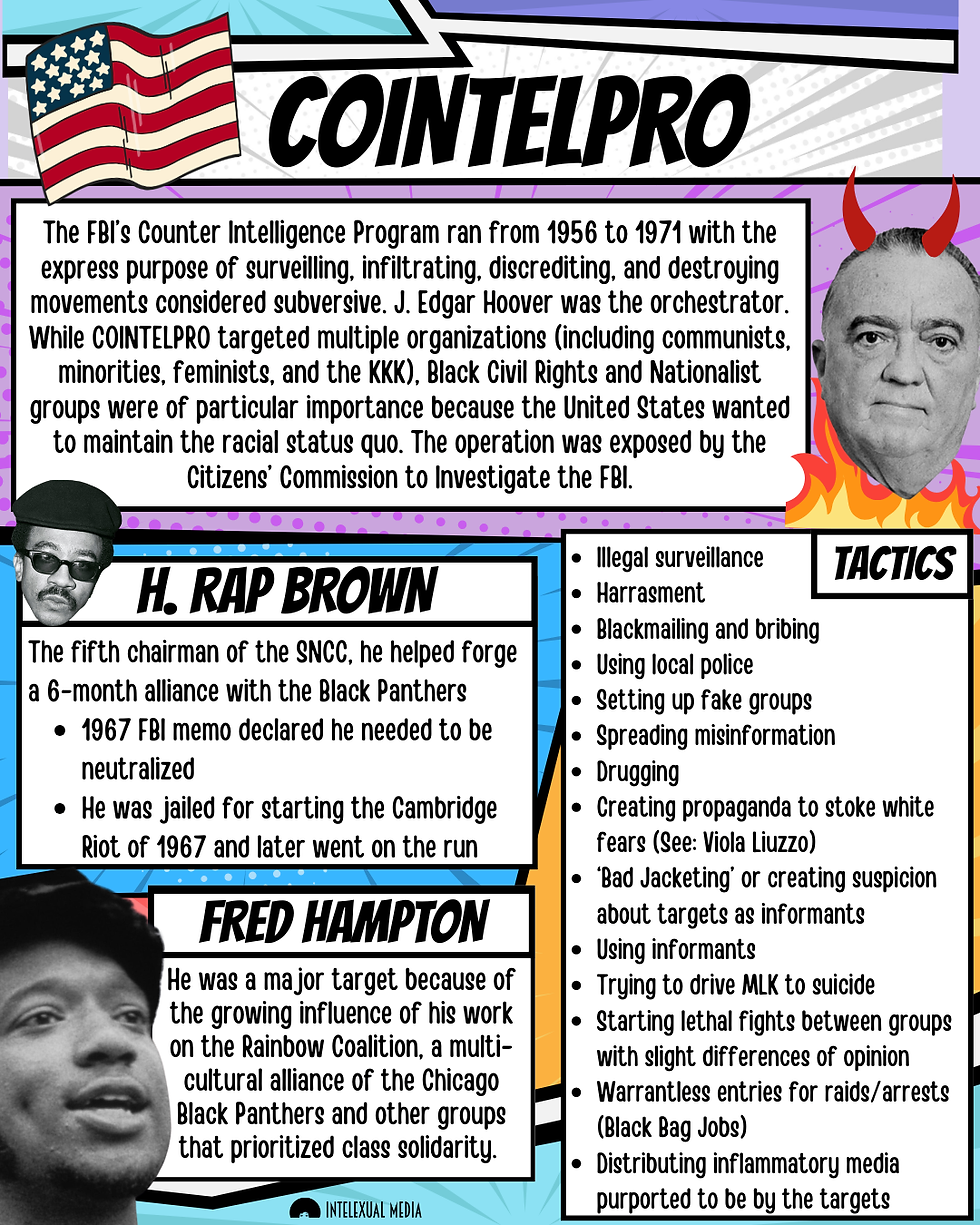
The full extent of COINTELPRO's operations is staggering. The FBI was so dirty that in 1964 it sent a tape recording of Martin Luther King's alleged sexual affairs and a letter implying that he should kill himself. The Citizens Commission to Investigate the FBI exposed the project in 1971 (by breaking into a Pennsylvania building and stealing files while most people were glued to their radios for the Fight of the Century between Joe Frazier and Muhammad Ali), but this didn't mean other operations weren't happening, as exhibited by Project MINARET. The last Democratic senator of Idaho, Frank Church, led an investigation into U.S. intelligence agencies, like the FBI and the NSA. The 1976 Church report said, “The unexpressed major premise of much of COINTELPRO is that the Bureau has a role in maintaining the existing social order, and that its efforts should be aimed toward combating those who threaten that order.”
1960s Racism Tracker
The Birmingham Church Bombing (1963)

Four KKK members bombed the 16th Street Baptist Church on September 15th, killing Addie M. Collins (14), Cynthia Wesley (14), Carole Robertson (14), & Carol D. McNair (11).
The Murder of Cynthia Scott (1963)
Cynthia Annette Scott was a 24-year-old sex worker in Detroit who was harassed by police in the early morning hours of July 5th, 1963
According to witnesses, she attempted to walk away from being arrested
The cops claimed that Cynthia attacked them
Officer Theodore Spicher shot her three times in the back, killing her, and Officer Robert Marshall helped him cover it up
When her homicide was ruled “justifiable”, over 2500 Black Detroiters rallied in her name outside of police headquarters. This is very notable because of her occupation as a sex worker. Most of the people who rallied for Cynthia against police brutality were left-leaning, radical, or similarly marginalized by occupation
She faced harsh newspaper coverage, with Brianna Wells and Mix Mann writing,
"Newspapers such as the Detroit Free Press hyper-focused on Cynthia Scott's height and weight, as though her stature implied deviance. Nearly all of the descriptions of her in the media involved words like “big” and “tough.” Coverage of her murder emphasized her status as a “known prostitute” and often described her criminal history in detail. (The Free Press also published Cynthia's police mug shot, whereas the Michigan Chronicle, an African American weekly newspaper, obtained a photograph of Cynthia from her mother). These portrayals of Cynthia were undoubtedly intended to justify the actions of Officer Theodore Spicher. The articles often weaponized her reputation as a “known felon” as though it were a death sentence, while they attempted to rationalize Spicher’s use of deadly force."
Cynthia's killer and co-conspirator never faced consequences, and the event would be one of several catalysts for the 1967 Detroit Riots
Read: What Happened to Cynthia Scott? by Mix Mann and Brianna Wells
The Neshoba Murders (1964)
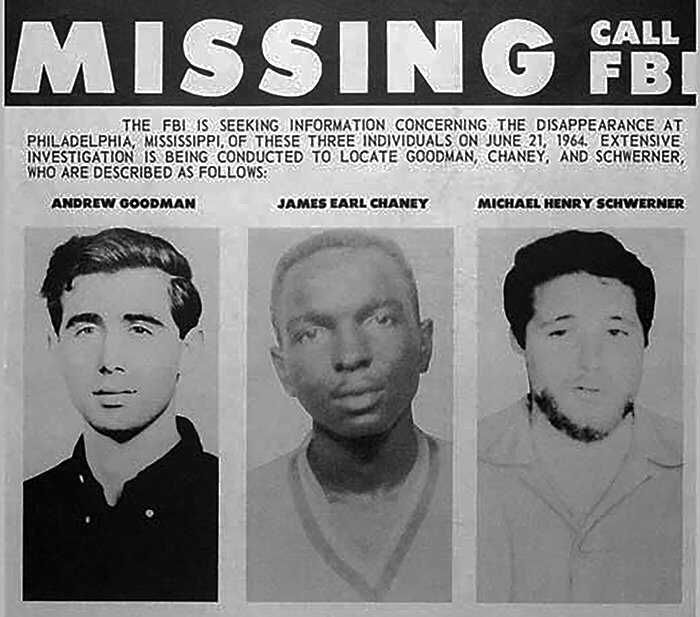
In June 1964, COFO members James Chaney, Mickey Schwerner, and Andrew Goodman traveled to Neshoba County to investigate the arson of Mount Zion Methodist Church. They didn't know they had been intentionally lurked by area members of the Klan, who wanted to send a message to everyone working on voter registration. When passing through Philadelphia, Mississippi, the trio was stopped and arrested for arson and speeding. They were jailed and released from police custody that same night. They were kidnapped by the Sheriff's deputy and the Klan and murdered before being dumped into a dam. They were reported missing, and President Johnson ordered the FBI into Mississippi to find the men. When investigators combed Neshoba County, they found at least 10 unidentified Black corpses. The Justice Department eventually charged 19 men under the Civil Rights Act with "conspiracy to deprive" the three COFO workers of their civil rights. 7 men, including the Sheriff's Deputy, were convicted and sentenced to 3-4 years in prison.
James Meredith’s March Against Fear (1966)

Back in 1962, Meredith was the first Black student to successfully enroll at Ole Miss. In 1966, he decided to take his activism up a notch, planning a solo March Against Fear. Meredith’s 225-mile trek across Mississippi was temporarily halted when he was shot with a shotgun by a racist named Aubrey James Norvell. This attracted over 10,000 people to the Mississippi Delta to continue the march, many of them members of mainstream civil rights groups who didn’t exactly see eye to eye with Meredith. He rejoined the march 19 days later.
1960s Black Assassinations & Riots


1960s Black Education Fast Facts

By 1969, less than 3.6% of Black people over the age of 14 were illiterate. 99 years previously, this rate had been 79.9%
In 1960, 5.3 per cent of the undergraduates and 2.9 per cent of the graduate students were black. From 1960 to 1970, the number of blacks enrolled at higher educational institutions tripled, rising from 145,436 to 429,948
Black people made up 6.5 per cent of all undergraduates and 3.4 per cent of all graduate students by 1970
In 1960, while 40% of white adults were high school graduates, only 23% of Black people were
Between 1960 and 1970, the median years of school completed by black men (25-29) rose from 10.5 to 12.2.
The Higher Education Act of 1965 provided direct federal grants to HBCUs
Strapped education budgets from the loss of tax revenue from white flight meant inadequate inner-city schools
In 1960, 6-year-old Ruby Bridges integrated New Orleans schools. She faced daily threats and harassment and was the only student in her class for the first year.
Top 1960s Trends, People, & Performers

There are tons of other performers I could mention, including The Jackson 5, Ray Charles, Dionne Warwick, Marvin Gaye, Quincy Jones, and Etta James, but instead, check out this 1960s Black Hits playlist.

1960s Figure Spotlight: Nina Simone

Born in Tryon, North Carolina as Eunice Waymon, the future Civil Rights activist was just 12-years-old when she led her first protest: refusing to play the piano at a recital until her parents were able to sit with the white people in the seats near the stage. Nina attended a slew of specialty schools to study music (including Juilliard) and was singing jazz and blues in New Jersey by 1954. She released albums like Little Girl Blue and studied classical music. She made a variety of friends in the vanguard of Black culture, like James Baldwin and Lorraine Hansberry, who stimulated her consciousness.
Under a new label beginning in 1964, Nina addressed American racism through tracks like Mississippi Goddam. She believed this song led to her career stalling in America. She was noted for being more radical in her beliefs, aligning with Malcolm X’s vision of Black Nationalism over Martin Luther King Jr’s nonviolence rhetoric. Still, she was a participant in Civil Rights marches, often on hand to sing. It was during this time that Nina traded in straight hair for braids and natural styles.
Nina addressed misogynoir and beauty standards in Four Women. She also dedicated a performance to MLK after his murder and created a song (To Be Young, Gifted, and Black) for the deceased Lorraine Hansberry based on the playwright’s own material.
1960s Black Artists

Do you want to conduct your own research on the Black 1960s? Check out this A-Z list for inspiration!

Check out Intelexual Media Guides for details on how to do your own research.
In Black America Rewind: 1970s, we'll discuss:
Cultural Forces
Black Electoral Politics
& More!


Comments