


Black America Rewind: 1950s
Feb 2
17 min read
Updated: Feb 22
Our history will not be erased. In this near-weekly series, we'll focus on important Black American history from the 1920s to the 1990s. Full posts are available here, but you can follow along with the abridged versions on Instagram, too.

Despite the continuation of American racism, the 1950s shone with Rock n Roll, endless possibilities, bright new opportunities, and important works of Black culture. Because of heartbreaking tragedies and ongoing racial discrimination, new ideas and strategies emerged to catalyze the Civil Rights Movement. Since we had first been kidnapped and brought to this country, never before had we had so many privileges-- and so much to lose. Black Americans would never go back to the meek subservience that White America demanded before World War II.
1950s Ripple Effects

Important 1950s Black American Events
Brown v. Board of Education (1954)
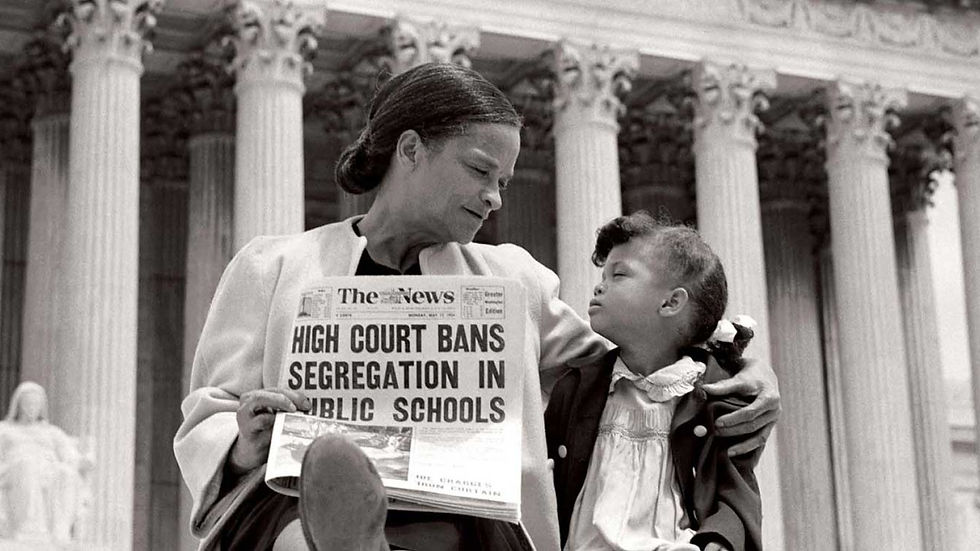
Most American racial segregation laws before 1954 rested on 1896's Plessy v. Ferguson, which ruled that segregating facilities was constitutional as long as they were equal
But segregated facilities weren’t equal. Gunnar Myrdal’s 1944 An American Dilemma found that southern states spent 2x on white students versus Black ones, 4x on facilities, and paid white teachers 30% more
In 1951, 13 parents (including Oliver Brown) filed a lawsuit against the Topeka, Kansas Board of Education for discriminating against their 20 children.
They were recruited by the local branch of the National Association for the Advancement of Colored People, who instructed the parents to attempt to enroll their kids at white schools.
The NAACP believed the lawsuit had a better chance with a Black father, Brown, at the helm of the plaintiffs
The district ruled in favor of the Board of Education, which was appealed and eventually made it to the Supreme Court
Brown combined NAACP-backed lawsuits in Kansas, South Carolina, Virginia, Delaware, and D.C.
The Supreme Court ruled in favor of the plaintiffs, overruling Plessy. This led to a 1955 directive to states to desegregate schools and served as a future basis for lawsuits.
Whites were pissed. (See: Massive Resistance)
Montgomery Bus Boycott (1955-1956)

On December 1st, 1955, Rosa Parks was arrested for refusing to give up her seat on a Montgomery public bus. It wasn’t the first act of defiance. Other women, including Aurelia Browder, Susie McDonald, and Mary Louise Smith had all been arrested for their acts of civil disobedience in the months before Rosa.

15-year-old Claudette Colvin was a pregnant student at Booker T. Washington High School in Montgomery in March 1955 when she refused to give her seat to a white woman and was arrested. Nine months later, when Rosa became the face of the movement because of her skin color, age, and respectability, Claudette was told to accept it. She'd later remark, "My mother told me to be quiet about what I did. She told me: 'Let Rosa be the one. White people aren't going to bother Rosa[,] her skin is lighter than yours and they like her."
After Rosa's arrest and conviction, the Women’s Political Council and the Montgomery Improvement Association (headed by area newbie Martin Luther King Jr.), organized a boycott of the city's buses
The city bus system faced extreme financial distress as Black people took taxis, rode in carpools, and walked for the next year
When the city found out that some Black taxi drivers were accepting fares for 10 cents (equal to the cost of riding a bus), the city ordered that drivers would be fined if they charged any fare less than 45 cents
At the same time as the boycott, the NAACP organized a lawsuit featuring Aurelia Browder, Susie McDonald, Claudette Colvin, Jeanetta Resse, and Mary Louise Smith as plaintiffs. (Browder v. Gayle)
They sued Montgomery mayor W.A. Gayle, city commissioners, the Chief of Police, the Montgomery City Lines, and the Alabama Public Service Commission
The District Court ruled in favor of the plaintiffs, but the defendants appealed the decision.
The Supreme Court ruled in Browder v Gayle that segregated buses were illegal. The boycott ended on December 20, 1956

While the solidarity of the Montgomery Bus Boycott was important (and definitely impacted Montgomery's coffers), it's unlikely that the Boycott would have been sustainable for much longer. The lawsuit brought against the Montgomery power structure helped make the boycott more effective and catalyzed the end of discrimination in all public accommodations in the future.

Martin Luther King Jr., Izola Curry, and Mental Health

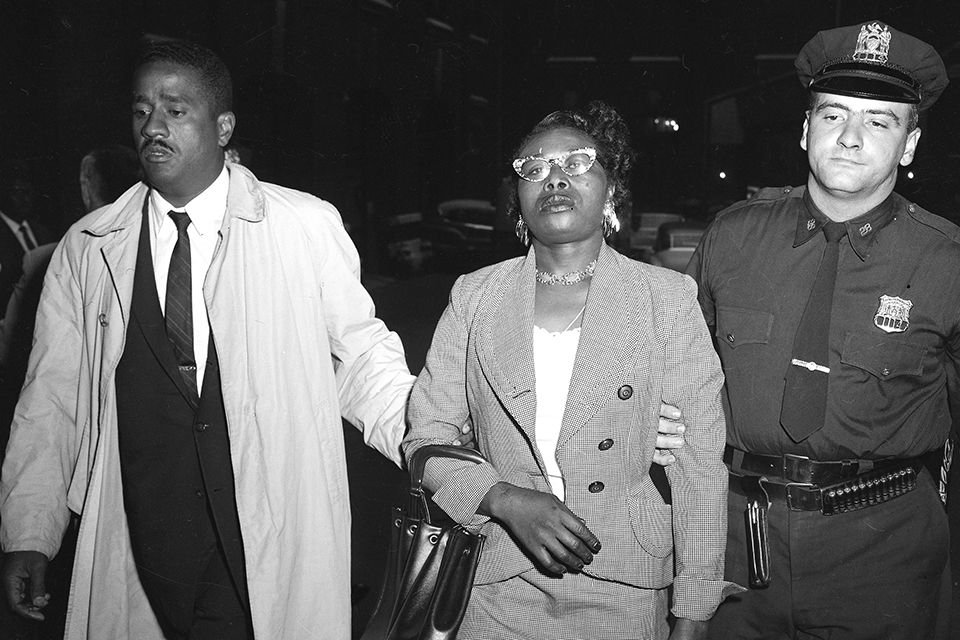
The 1958 stabbing incident highlighted MLK's ability to empathize and be compassionate. Born in 1916, Izola had grown up poor with seven siblings in Adrian, Georgia, in stark contrast to MLK's middle-class upbringing. After moving to New York in her early twenties, her mental health began to deteriorate due to schizophrenia. By the 1950s, her delusions led her to believe that the NAACP and King were conspiring to keep her unemployed. While King was meeting supporters on his book tour on September 20th at Blumstein's Department Store in Harlem, Izola pulled out a 7-inch steel letter opener and stabbed him in the chest. She was immediately seized, screaming, “I’ve been after him for six years. I’m glad I done it.” Two police officers (one white, one black) stopped an onlooker from attempting to pull out the blade, which they immediately knew would require delicate surgery.
In 1968, King recalled, "That blade had gone through, and the X-rays revealed that the tip of the blade was on the edge of my aorta, the main artery. And once that's punctured, you drowned in your own blood, that's the end of you. It came out in The New York Times the next morning that if I had merely sneezed, I would have died." Can you imagine how different the Civil Rights Movement would have been if Martin Luther King Jr. had perished on that September day in 1958? While recovering in Harlem Hospital after his life-saving surgery, King exhibited his compassion for the mentally ill, issuing a statement saying "I felt no ill will toward Mrs. Izola Currey and know that thoughtful people will do all in their power to see that she gets the help she apparently needs if she is to become a free and constructive member of society." Izola was diagnosed schizophrenic, found to have an I.Q. of 70, and assessed as being in a "severe state of insanity." She was committed to a mental hospital. King was re-affirmed in his belief in non-violence.
1950s Quick Facts & Cost of Living
Black population by 1960: 18.9 million (10.5% of the U.S.)
Black Female Birth Rate by 1960: 153.6 per 1000 women
The neonatal mortality rate per 1,000 live births was 17.8 for whites and 27.0 for “Negro and other”
Black Female Marriage Rate: 67%
National Divorce Rate: 2.1-2.5 per 1000 marriages
Interracial Marriage Rate: 0.1% of all unions
Median Annual Family Income (1955):
White: $4,613
Black: $2,514
Common Jobs: Factory work, military service, maids, caregivers, nurses, manual laborers, educators, beauticians, barbers, local retailers, sharecroppers, morticians, salesmen

The 1950s Black Middle Class

While approximately 55% of Black Americans lived below the poverty line by the end of the fifties, roughly 1% were middle class (earning over $5000 a year). They lived in areas like Detroit, where well-paying factory work and an emphasis on community helped pockets flourish
Approximately 75,000 Black people out of 15-18 million were ‘Middle Class’
Moving out of black neighborhoods to white ones could be dangerous (See: Cicero Race Riot)
The Black Middle class established businesses that provided jobs and services, patronized historically Black Colleges and Universities, and provided capital to organizations like the NAACP to levy lawsuits that improved the lives of everyone in the Black community.
The Black Middle Class also purchased property to build wealth (often becoming landlords), maintained exclusionary secret societies and clubs (like Jack and Jill), and regularly perpetuated classism, colorism, and featurism within their insular communities
The spending power of the Black Middle Class made them a soon-to-be lucrative target of advertising featuring Black people, which would be key to the success of publications like Ebony and Jet
Important 1950s Ideas
Non-Violent Civil Disobedience

Inspired by Gandhi and non-violent principles in India’s battle for independence from Britain
White racists being violent animals held new resonance for multiple reasons:
The advent of live video coverage and the growing importance of mass media exposed their evils for all to see
Footage of calm, non-violent Black people directly contradicted long-running American propaganda that Black people are naturally violent
Because America wished to distance itself from the eugenics and racism that permeated its WWII enemy, Nazi Germany, international coverage of racism in the United States embarrassed the nation in front of its allies
Youth Participation


Civil Rights Activism was not limited to adults-- teenagers were willing to resist and reject racism, like the Youth Marches for Integrated Schools. The first one was on October 25, 1958 in Washington, D.C., attracting approximately 10,000 high school and college students who were organized in part by A. Phillip Randolph. They demanded the implementation of Brown v Board of Education's orders. Martin Luther King Jr. had been scheduled to speak at the event, but was still in the hospital recovering from Izola Curry's stabbing. Coretta Scott King delivered a speech on his behalf. The following year, 26,000 high school and college students marched on Washington in 1959, This time, Martin Luther King Jr. gave a speech, along with Harry Belafonte, Daisy Bates, and Jackie Robinson. The Youth Marches, like much of the Civil Rights Movement, was accused of being a communist front. The day before the second march, Randolph, King, and Roy Wilkins issued a statement, saying, "The sponsors of the March have not invited Communists or communist organizations. Nor have they invited members of the Ku Klux Klan or the White Citizens’ Council. We do not want the participation of these groups, nor of individuals or other organizations holding similar views."

1950s Racism Tracker
White people were not happy about the fragile gains made by Black Americans in the 1950s.
The Cicero Race Riot (1951)
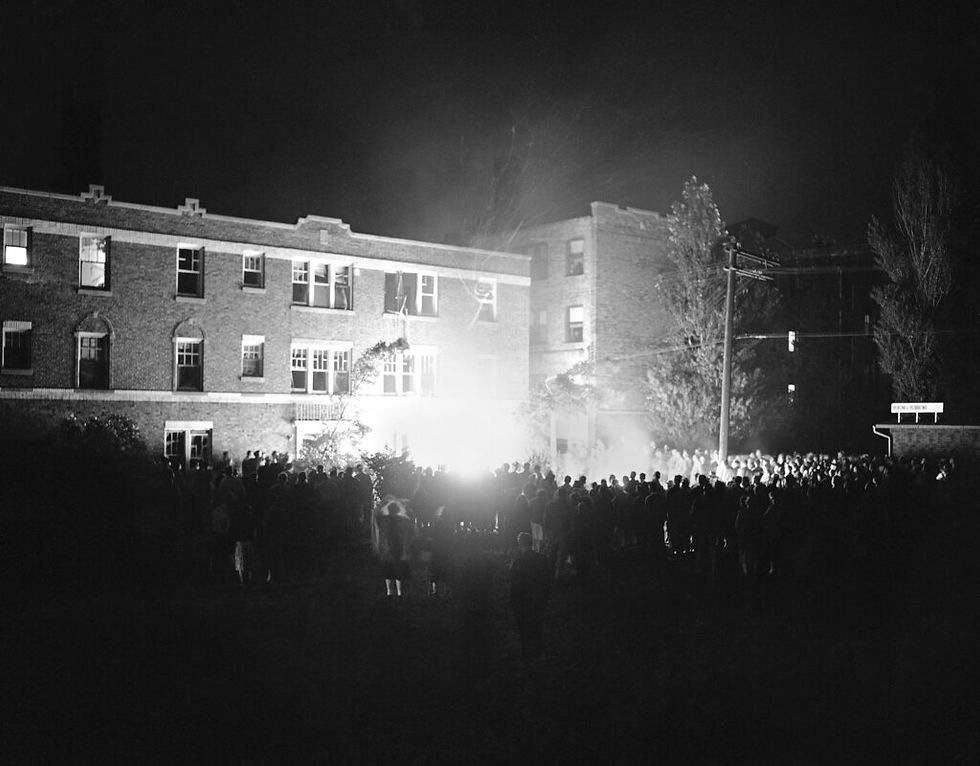
In July 1951, over 4,000 white people and 60 members of the Cicero Police Department in Illinois attacked an apartment building because a Black war veteran named Harvey E. Clark Jr., his wife, Johnetta, and their family moved in. Women, men, and teens caused $20,000 in damages and firebombed the building.
The Clark family of five paid $56 to live in half of a two-bedroom apartment (that they shared with another family) in the city of Chicago. The $60/month five-bedroom apartment at 6139 West Nineteenth Street in Cicero seemed like a Godsend
When they first tried to move in, they were blocked and threatened by police. The family turned to the NAACP, who successfully sued for them to move in
Most mob participants were Eastern European immigrants and teenagers
118 men were arrested, but none were ever indicted or charged with crimes
When the Clarks fled, the angry mob entered their apartment and destroyed all of their belongings before firebombing the building (which also destroyed white people's homes)
Governor Adlai Stevenson called the National Guard in to end the riot, which hadn't happened since the 1919 Chicago Race Riot
Harvey and Johnetta's daughter, Michele, became one of the first Black TV correspondents before her untimely death due to a plane crash in 1972
White Citizens Councils (1954)


Founded in 1954, just two months after Brown v Board of Education in Mississippi, this organization worked to oppose Black voter registration efforts, to disseminate propaganda, intimidate Black people with violence, and uphold segregation by organizing Massive Resistance. Membership peaked at 60,000, including politicians and housewives. These racists met openly (unlike the Ku Klux Klan), and broadcast their hatred on radio and TV programming from 1957 to 1966. They also funded segregation academies ( in Mississippi, they created a system of 12 'Citizen Schools'), produced children's books, and published a newsletter. Mississippi Governor Ross Barnett, along with other influential politicians, was a member.
The Little Rock Nine (1957)
As part of a minimum effort to integrate Arkansas schools, Little Rock Central High School was selected as the sole institution to enroll Black students in 1957
Nine students were selected to begin school on September 4th
Melba Pattillo
Ernest Green
Elizabeth Eckford
Minnijean Brown
Terrence Roberts
Carlotta Walls
Jefferson Thomas
Gloria Ray
Thelma Mothershed

Governor Orval Faubus (who was due to run for a 3rd term) opposed the integration effort, ordering the Arkansas National Guard to support white supremacists who showed up to harass the students.
White people yelled epithets, threw objects, and spat on the Black teenagers, blocking the entrance when they attempted to enter the school. The media coverage was an international embarrassment.
Remembered Elizabeth Eckford, "I tried to see a friendly face somewhere in the mob—someone who maybe would help. I looked into the face of an old woman and it seemed a kind face, but when I looked at her again, she spat on me".

President Dwight Eisenhower took control of the Arkansas National Guard and sent in the army to escort the students to school on September 24th
The nine brave students who attended were assaulted and harassed in school, with Melba Patillo suffering an acid attack to her eyes
Faubus retaliated by closing the city’s four public schools from 1958-1959, which was an example of Massive Resistance. When schools reopened, black students suffered violence and harassment
Massive Resistance

In response to Brown v Board of Education, white Americans across the country resisted forced integration by un-enrolling their children from public schools and putting them in private ‘Segregation Academies.’
In Prince Edward County, Virginia, public schools were shuttered in 1959 because leaders refused to give them any money
As a result, some Black students moved in with relatives in other counties to attend schools. Others received some schooling in church, and over 1,000 received no education for four years.
Prince Edward County was ordered to reopen its schools in 1963

Even though schools were increasingly integrated in the years that followed, Segregation Academies continued for decades to come. It was not made illegal to deny a student admission to a public school based on race until 1976's Runyon v. McCrary. Eventually, schools that refused to comply with this ruling lost their tax-exempt status or begrudgingly integrated.
Segregating Bandstand

Despite being initially first-come, first-served, the popular Philly-based TV production American Bandstand (like a mid-20th-century version of Total Request Live or Soul Train) refused to admit most black teenagers in 1954, making the audience lily-white until 1964 when it relocated to Los Angeles. Explained Jonathan Kay,
"There was no explicit Bandstand policy that excluded blacks. But numerous insiders cited... Delmont describe an informal policy of references, name-checks and committees that effectively served the same purpose. And, in fact, if you look through the available Bandstand still images and footage from the late 1950s ...you will see very few black faces (though you will see plenty of Italians from the nearby West Philadelphia Catholic schools, and, surprisingly, a good number of Jews). Only when the show moved to Los Angeles in the 1960s would the racial mix become more representative."
The Murders of Harry and Harriette Moore (1951)
In addition to publicizing lynchings, the Moores had helped grow NAACP membership in Florida to over 10,000. In fact, Harry founded the Brevard County chapter of the organization in 1934. As a teacher, Harriette took pride in educating her students on real Black history. On Christmas 1951, when celebrating their 25th wedding anniversary, their home in Mims, Florida, was firebombed by 4 members of the KKK. The couple both died as a result of the bombing, leading to protests and a January 5th 1952 memorial service by Jackie Robinson with 3,000 mourners and a NAACP-backed memorial at Madison Square Garden in March with 15,000 mourners.
The perpetrators, Joseph N. Cox, Early J. Brooklyn, Tillman H. Belvin, and Edward L. Spivey, were never charged. Cox killed himself in March 1952, one day after being questioned by police. Belvin died in August 1952. Brooklyn died on Christmas Day 1952. Spivey died of cancer in 1980.
The Murder of Emmett Till (1955)

Emmett Louis Till was born on July 25, 1941, in Chicago to Mamie Till. Nicknamed ‘Bobo’, Till survived polio at the age of 6, which left him with a stutter. As a child in Chicago, he took pride in his clothing, loved pulling pranks, playing baseball, and telling jokes. At age 11, when his mother’s estranged second husband, Pink, became threatening and abusive, Emmett bravely grabbed a kitchen knife and said he’d kill the man if he didn’t leave. In August 1955, Emmett traveled to Mississippi to spend time with his family. His mother warned him to ‘behave’ in front of the ignorant white racists who lived there before she put him on the train headed south.
On August 24th, Emmett went to buy candy with a handful of cousins, including Maurice Wright. It has long been debated and disputed if Emmett ‘flirted’ with, whistled at, and/or grabbed the white 21-year-old Carolyn Bryant at Bryant Grocery and Meat Market in the town of Money. She claimed that he whistled at her, showed off a picture of his white girlfriend, and grabbed her while making lewd comments. Journalists at the time reported this as fact and claimed that Carolyn's story was corroborated by Maurice. Said Maurice in 2015, "We didn't dare him to go to the store—the white folk said that. They said that he had pictures of his white girlfriend. There were no pictures. They never talked to me. They never interviewed me." Additionally, because of Emmett's speech impediment, he whistled before pronouncing words.
None of this mattered in the grand scheme of things. Even if Emmett's worst offense had been grabbing the white woman in broad daylight (which Carolyn even recanted later and admitted he did not do), it did not warrant murder. Her husband Roy, and his half-brother accomplice, J.W. Milam, abducted Emmett from his family’s home, tortured him, and lynched him on August 28, 1955.

Emmett's body was found in the Tallahatchie River three days after he was kidnapped. Tallahatchie County Sheriff Clarence Strider tried to claim that the corpse wasn't Emmett and speculated that he was still alive somewhere, prolonging the indictment of Roy and J.W. When they were finally charged, they raised approximately $117,000 in today's money for their legal defense. They were represented pro bono by attorneys at Sumner Law Firm. Meanwhile, the White Citizens Council twisted the tragedy, saying that segregation policies were necessary to keep Black people safe. An arrest warrant was drafted for Carolyn Bryant, who was believed to have been in Roy and J.W.'s car when they dragged Emmett from his home-- but it was never served.

A 5-day farce of a trial in September led to a not-guilty verdict by a beer-drinking, all-white, all-male jury. They listened with fury as the defense claimed that Emmett had grabbed Bryant and been dragged out of the store by one of his cousins (false). They took 67-minutes to deliberate, with one juror noting, "If we hadn't stopped to drink pop, it wouldn't have taken that long." Despite the acquittal, the indictment of the men was a small sign that the tide was changing (albeit barely). Also, Emmett's uncle, Mose Wright, who had been threatened and assaulted when the pair kidnapped the 14-year-old from his home, bravely identified the men in court. After the not-guilty verdict, Roy and J.W. gave a paid interview to Look Magazine, admitting to the murder and insinuating a larger cover-up at play. Said J.W.,
"Well, what else could we do? He was hopeless. I'm no bully; I never hurt a nigger in my life. I like niggers—in their place—I know how to work 'em. But I just decided it was time a few people got put on notice. As long as I live and can do anything about it, niggers are gonna stay in their place. Niggers ain't gonna vote where I live. If they did, they'd control the government. They ain't gonna go to school with my kids. And when a nigger gets close to mentioning sex with a white woman, he's tired o' livin'. I'm likely to kill him. Me and my folks fought for this country, and we got some rights. I stood there in that shed and listened to that nigger throw that poison at me, and I just made up my mind. 'Chicago boy,' I said, 'I'm tired of 'em sending your kind down here to stir up trouble. Goddam you, I'm going to make an example of you—just so everybody can know how me and my folks stand.'"
Despite facing no judicial consequences, their brazen admission in the magazine eroded their support and played a role in the passage of the 1957 Civil Rights Act. Presented by Congressman Adam Clayton Powell Jr, it was the first Federal Civil Rights legislation since Reconstruction. Though it passed in the House, it was essentially neutered of its most important provisions in the Senate. However, an important aspect remained: the U.S. Department of Justice was authorized to intervene in state and local law enforcement investigations when it was determined that civil rights were in jeopardy.
When Mamie received her son's body back home in Chicago, she was horrified. "There was just no way I could describe what was in that box. No way. And I just wanted the world to see." she said. She chose to have an open-casket memorial and let Jet Magazine and the Chicago Defender publish photos of Emmett's deformed corpse, sparking national outrage. Mamie’s pain became a rallying cry of the Civil Rights Movement. In Chicago, over 50,000-100,000 people attended Emmett's funeral services and viewed his body at Roberts Temple Church of God. Wrote Isabelle Wilkerson in The Warmth of Other Suns, "How many of them had sent their children south to be with their cousins and grandparents, giving them the same warnings Mamie Till had given her son-- that they mind themselves around white people?"

One month after the trial, it was reported that Emmett's father had been arrested, convicted, and executed for the rape and murder of an Italian woman during World War II, lending credence to Carolyn's accusations despite the conflicting witness statements, her inconsistent story, and the violent crime that followed.

Martin Luther King Jr, who had not yet been asked to be involved with the Montgomery Bus Boycott that would elevate his profile, noted the hypocrisy of the white 'Christians' who supported Emmett Till's murderers, saying,
“The white men who lynch Negroes worship Christ. That jury in Mississippi, which a few days ago in the Emmett Till case, freed two white men from what might be considered one of the most brutal and inhuman crimes of the twentieth century, worships Christ. The perpetrators of many of the greatest evils in our society worship Christ. This trouble is that all people, like the Pharisee, go to church regularly, they pay their tithes and offerings, and observe religiously the various ceremonial requirements. The trouble with these people, however, is that they worship Christ emotionally and not morally. They cast his ethical and moral insights behind the gushing smoke of emotional adoration and ceremonial piety."
1950s Black Education Fast Facts

In 1952, the illiteracy rate for Black people 14 years of age or older (10.2 percent) was more than five times that of whites (1.8 percent).
In 1950, less than half of the nation’s Black youth attended High School; by 1970, the proportion increased to nearly two-thirds
In September of 1956, the New York Times reported that some 300,000 black children attended integrated schools in nearly 800 districts.
1950's Sweatt v. Painter successfully challenged segregation in graduate schools when Heman Marion Sweatt was barred from attending the University of Texas’s School of Law. It became foundational to Brown v. Board of Education
Historically Black Colleges and Universities served approximately 90% of the Black people pursuing Higher Education (compared to 8% today)
HBCUs also produced 75% of all black Ph. D.s, 75% of all black army officers, 80% of all black federal judges, and 85% of all black physicians.
Top 1950s Trends, People, & Performers

The Rise of Black Hollywood
For better or worse, the 1950s signaled an elevation of Black Hollywood's influence.
Harry Belafonte Leverages Power

The same year that he starred in 1954's Carmen Jones with Dorothy Dandridge, he committed to not performing in the South until 1961
His 1956 album Calypso was the first solo artist album to sell over 1 million copies
MLK Jr. tapped Belafonte to spread the word about the Montgomery Bus Boycott, beginning a long-running partnership to marry activism with celebrity. He frequently aided the Civil Rights movement as an active participant and financier.
Nat King Cole Shatters Stereotypes

The Nat King Cole Show began airing on NBC in 1956, bringing attention to Black artists such as Mahalia Jackson and Pearl Bailey. It aired 64 episodes, showing the culture and intelligence of Black Americans without the stereotypes that whites loved
The show ended due to a lack of sponsorship money. White corporations didn’t want Black people selling their products, and they also disliked the lack of stereotypes
Dorothy Dandridge Lights Up The Screen

Dorothy Dandridge’s performance in 1954's Carmen Jones established her as one of Hollywood’s first Black sex symbols
This was important because Black women were previously relegated to static mammy roles that made white people comfortable
The same year, she became the first Black woman featured on the cover of Life
The film made over $10 million at the box office and Dorothy was the first Black woman nominated for Best Actress at the Oscars
1950s Figure Spotlight: Septima Poinsette Clark

Born in 1898 in Charleston, South Carolina to a formerly enslaved father and Haiti-raised mother, Clark’s family, despite being poor, valued education. In exchange for babysitting an elderly woman's children at 6-years-old, she learned to read and write. After being one of the first Black teens in Charleston to graduate from high school, she became a teacher on John’s Island before eventually earning a master's degree. In her spare time, she taught illiterate Black adults to read, developing a rapid method over time. She joined the NAACP in 1918 and taught at numerous schools.
In the fifties, Septima was tapped by the white socialist and educator Myles Horton to become a full-time director of adult literacy workshops. Her workshops helped turn poor and illiterate Black people into informed voters with basic literacy skills in roughly a week. In 1956, she became Vice President of the Charleston NAACP. When Charleston passed a law banning teachers from participating in civil rights organizations that same year, she lost her teaching job. Septima, who was also instrumental in organizing the Montgomery Bus Boycott, expanded her literacy workshops into ‘Citizenship Schools’ sponsored by the SCLC. Hundreds of thousands of Black people attended these schools throughout the 60s.
1950s Black Artists

Do you want to conduct your own research on the Black 1950s? Check out this list from A-Z for inspiration!

Check out Intelexual Media Guides for details on how to do your own research.
In Black America Rewind: 1960s, we'll discuss:
The Civil Rights Movement
Black Power
Assassinations, COINTELPRO, and Urban Unrest
& More!


Bài viết của bạn gọn gàng mà rõ ràng, mình đọc liền một lượt là nắm được ý chính nên thấy rất dễ theo. Cảm ơn bạn đã chia sẻ nhé. Mình cũng có thói quen xem thống kê XSMB hằng ngày, nhưng hồi trước phải mở nhiều nơi để đối chiếu nên khá mất công. Sau này mình tự gom lại cho tiện, chủ yếu để lưu lại và lúc cần thì tra nhanh, chứ không phải lúc nào cũng nhớ hết các số liệu. Mình để chung trên soicau247.com cho dễ quay lại xem, đỡ phải chuyển tab liên tục. Khi rảnh rỗi mình hay mở ra so sánh một chút, thấy tiết kiệm thời gian hơn hẳn.…